What Does AX Mean? AI Transformation vs. DX and 3 Workplace Bottlenecks
Who this is forOffice workers who first heard the term AX at their company and looked it up, and staff assigned an AX project who don't know where to start.
Series · AI automation glossary part 13 of 13, expand to see all
- What Is an API? Understanding It with One Snack Bar Order Slip
- What Is a Webhook? Understanding It With a Restaurant Waiting Ticket
- What Is a Server? A Computer That Stays On When Yours Doesn't
- What is a terminal? A plain-English guide to the CLI and shell
- AI automation terms explained: MCP, agent, context, skill, and secret
- Claude terms explained: Projects, Artifacts, Cowork, and scheduled tasks
- What Is a Database? Why Tables Look Alike but Lock Differently
- What Is Supabase? Tables, Auth, and Server Functions in One Place
- Auth and RLS Explained: Keep the Screen Open, Lock the Data
- What Is Google Apps Script? Running Your Code on Google's Servers
- What Is Playwright? Why AI Suddenly Opens a Chrome Window
- What Is Aside? An Agent Browser That Clicks Using Your Own Logins
- What Does AX Mean? AI Transformation vs. DX and 3 Workplace Bottlenecks
TL;DR: AX is short for AI Transformation. If DX (digital transformation) was about moving paper and manual work into systems, AX is about redesigning the order of work and some judgment calls around AI. At companies, AX bottlenecks are usually not the tools but undefined work, missing data, and unchanged rewards. A bottleneck is a point where the whole flow slows down because of that spot.
Contents
- What does AX stand for?
- How is it different from DX?
- Why is everyone talking about AX now?
- Three bottlenecks that stall AX at work
- So what do you do first?
- Summary
1. What does AX stand for?
In a meeting, someone may say, “We need to take on an AX project this year too,” and nobody explains what AX stands for. This article covers the meaning of the term, and the things you actually run into at work once you know it.
AX is short for AI Transformation. In Korean it is called “AI jeonhwan” or “ingongjineung jeonhwan” (both mean AI transformation). Two spellings appear in official government documents:
- The Ministry of Science and ICT (MSIT) announced regional projects in December 2025 and wrote “AX (AI jeonhwan) project”.
- The Ministry of Trade, Industry and Energy (MOTIE) used “artificial intelligence transformation (AX)” in a project name in June 2025.
Why AX and not AT, if it is AI Transformation? The digital transformation entry in the Hankyung Economic Glossary (a dictionary from a Korean business newspaper) explains that English speakers shorten Transformation to X, so DX is used more often than DT. You read the X in AX the same way.
2. How is it different from DX?
DX came before AX. DX is Digital Transformation. The same dictionary defines DX as using digital technology to innovate a business.
There is no official standard that separates AX from DX. But one government document shows their order. In a document introducing the AX demonstration industrial complex project, MOTIE said that industrial complexes had built digital infrastructure to lay the groundwork for digital transformation, and that this time, going one step further, AI would be introduced in earnest on industrial sites. Digital transformation comes first, and AI transformation builds on top of it.
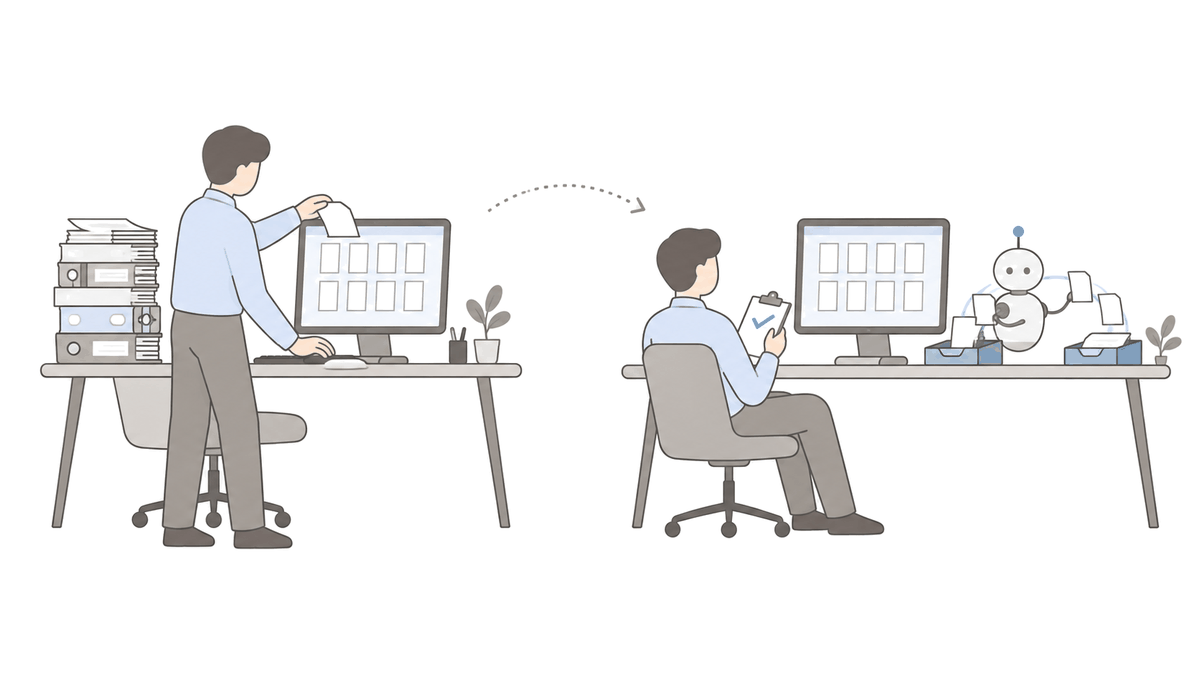
The table below spells out this order in terms of office work. It is not an official classification.
| Category | DX (Digital Transformation) | AX (AI Transformation) |
|---|---|---|
| What changes | Paper and manual work moved into systems and data | Some processing and judgment people did moved to AI |
| Example | Paper approvals become e-approvals | AI drafts approval documents and checks for omissions |
| What people do | Enter and look up data in systems | Design the order of work, review results |
| What must come first | Systems | Defined work, accumulated data |
A company that has finished DX can say, “Our data is in the system.” A company that has reached AX can say, “AI does part of the work with that data, and people check it.”
What you gain is the time that work used to take. In a manufacturing group’s presentation I heard at a conference, automating the review of production records cut a task that took up to 6 days down to 2.
3. Why is everyone talking about AX now?
One reason you can verify is that AX appears in government project names. Counting only those announced since 2025, there are four.
| Date | Announcement | Scale |
|---|---|---|
| June 2025 | MOTIE calls for proposals for the AI transformation (AX) demonstration industrial complex build-out project | 10 industrial complexes, KRW 140 billion in national funds through 2028 |
| December 2025 | MSIT announces the start of the four-region AX projects | KRW 3.1 trillion |
| March 2026 | MSIT, MOTIE, and the Ministry of SMEs and Startups (MSS) issue a joint notice for major AX projects | 11 projects, KRW 423 billion |
| June 2026 | Announcement of the Manufacturing AI 2030 strategy | KRW 20 trillion in combined public and private investment through 2030 |
The KRW 20 trillion in the last row is not only government budget. It is an amount that the government and private companies plan to invest together. The article calls this project “manufacturing AI transformation” (M.AX).

Since AX appears as a project name in the notice, companies applying for these projects will use the same word in their plans. Most of these projects, though, target manufacturing and local industrial sites. For an office team, AX is a smaller question: which of the tasks our team repeats can AI take over?
4. Three bottlenecks that stall AX at work
The meaning is simple, but in practice you get stuck often. I picked three spots from what I have written before.
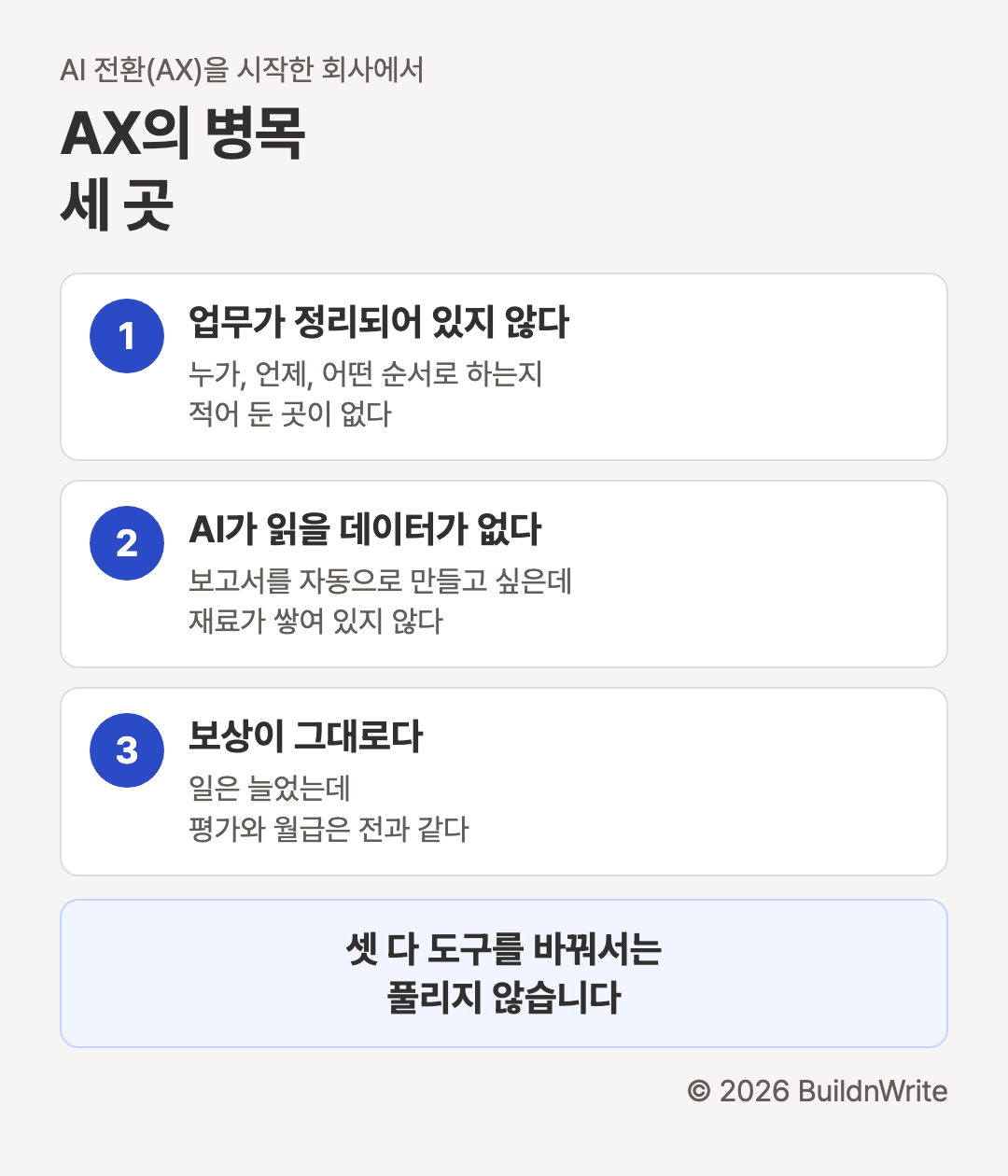
The work is not defined
When you take on an AX project, you want to start by choosing an AI tool. But in the adoption mentoring I have done, the first thing I did with the owner was not tool selection; it was documenting the existing work process. If nobody has written down who does what, when, and in what order, you cannot decide what to hand to AI either.
The AI has no data to read
The second is data. I once wrote this on Threads:
AX fantasy: Connect AI agents!! One-click automation! Executive PPT report done!
AX reality: Do you have that data? You don’t? 🫨 You’re going to start collecting it now? 😏
(my Threads post, May 27, 2026)
For AI to write a report for you, the records that become the report’s raw material need to have piled up first. The same point comes up in manufacturing. In the Q&A of MSIT’s 2026 work plan briefing, the answer on manufacturing AX was that building AI models is not the only thing that matters; relevant data has to be collected well, and the field lacks data.
Three weeks later, another Threads post said, “That’s not possible because of security… oh, wait, that one has no data.” Security can be a bottleneck too, but I did not include it among the three here.
Rewards stay the same
The third is people. I have a story from a student that I wrote on Threads. A PoC is a small trial built before a full rollout.
A student who built a PoC really well was given a full AX rollout project as a prize
This is about a student who took a corporate course
- Built one PoC at the company
- It ran really well
- The company assigned the full AX rollout project
- Then they got a request for private tutoring from me
The reward for the PoC was not praise but a bigger project 🫠
(my Threads post, September 26, 2026)
If the person who did the good work gets more work and the same evaluation and pay, nobody will step up next time.
Even before you try to set rewards, there is something you need first:
5. So what do you do first?
All three bottlenecks cannot be solved by changing tools. So the starting point is also one piece of work, not a tool. Pick one task your team repeats and write down the four items below. These were the first things I sorted out with the owner in the adoption mentoring.
- Where the data comes from
- How often it repeats
- How long one run takes, and where people make mistakes
- What exceptions exist
Once these four are written down, the parts for AI and the parts for people to check separate out. Items 2 and 3 get recorded as they are and serve as the baseline for comparing later what was reduced and by how much.
After writing these down, decide whether this is something one person can push forward alone or something that has to be worked out with the organization. You can test that with three self-check questions before adoption, which ask about authority, success criteria, and budget.
There is more to do after building it. If the thing exists only as one person’s file, it still belongs to that person. It has to be moved into flowcharts and explanations to become the company’s. After hearing two companies present at a conference, I came to see this as the finish line of AI transformation. That post also covers why training, even when run many times, does not take root inside the company.
Among the three bottlenecks, it may be hard to tell which one your company has. I offer coaching that helps teams pick one task and build an agent for it themselves. In the first consultation, we define that one task and its completion criteria. Below the post, I have put the coaching details and a link to an open KakaoTalk chat room (KakaoTalk is South Korea’s dominant messaging app), where you can ask about the exact spot where you’re stuck.
6. Summary
Frequently asked questions
- What does AX mean?
- AX is short for AI Transformation (AI jeonhwan in Korean). Government documents also write AX (AI jeonhwan). It refers to redesigning work order and some judgment calls around AI, not just adding AI tools.
- How are AX and DX different?
- DX (digital transformation) moves paper and manual work into systems and data. AX has AI take over some processing and judgment people did on that data. No official standard separates them, but MOTIE described AX as going a step beyond building digital infrastructure by introducing AI.
- What should I do first to start AX at my company?
- Before picking tools, choose one task and write down four things: where its data comes from, how often it repeats, how long it takes and where errors happen, and what exceptions occur. Once these are written, you can see which parts to hand to AI and which parts people should check.
Want the full system? The Claude Code & Codex Skills guidebook collects the skills and subagents behind this blog, from $19.
BuildnWrite helps teams build AI agents that keep running. About BuildnWrite ›