Claude Skill Selection Criteria: 3 Rules From 82 Skills I Built and 27 I Used
Who this is forPractitioners who have installed several Claude Code or Codex skills without a clear rule for which to keep, and team leads who must decide whether external skills are safe to bring into their company.
TL;DR: For Claude skills, the selection criteria matter more than how many you have. I built 82 and used 27, and from that I set three criteria: updated within the last 90 days, a license that allows company use, and a clearly matching situation. I published the 56 skills I picked with these criteria for free in 〈Claude Codex Skill Guidebook〉. Thirty are external skills and 26 are ones I build and use myself.
Contents
- Skills Are Harder to Choose Than to Build
- I Built 82 and Used Only 27
- Three Criteria for Choosing Claude Skills
- Popular Repositories I Did Not Include
- The 56 Skills Included in the Guidebook
- How I Re-Select Every Week
- When Choosing Skills for a Team
Even when you install several Claude skills from a recommendation list, you only call some of them in practice. I was no different. I kept 82 skills and used 27 of them over 110 days. This article doesn’t add another recommendation list. Instead, it lays out three criteria for deciding what to keep from a list, and where to check each one.
1. Skills Are Harder to Choose Than to Build
Skills are instruction manuals an agent pulls out when it needs them. The official docs describe them this way:
- Write instructions in a SKILL.md file, and Claude uses the skill when a request is relevant.
- A person can also call it directly with
/skill-name. - The skill format follows a public standard shared across several AI tools (Agent Skills).
Codex, the coding agent from OpenAI, also reads SKILL.md, following the same standard.
If the word skill is unfamiliar, read 5 AI automation terms first. If you want to see the screen for installing skills from a catalog, the marketplace section of Claude terminology is a good start.
Building is easy, so the count grew first. In GitHub code search, files with SKILL.md at the top of a repository numbered 45,312 as of October 2, 2026, up from 43,840 on September 16.

2. I Built 82 and Used Only 27
I counted my own computer first. These are skill invocation counts from session logs, collected on September 16, 2026.
- After 8 months of using Claude Code, my computer had 82 skills.
- In 110 days, only 27 of those skills were used even once. The other 55 were never invoked in that period.
- The most-used skill was the session wrap-up procedure, at 77 uses.
This is a post I put up on Threads when I published the book.
Three criteria I use when choosing skills
- Still maintained: updated within the last 90 days
- Usable at work: License: free
- Fits my work: the situation it’s for is clear
Set after 8 months of Claude Code, adopting 82 and using only 27.
(Threads @buildnwrite, posted September 18, 2026)
Making a skill doesn’t mean it gets used. So I first decide what gets made into a skill. This is the decision table from the What Is a Skill chapter of the guidebook.
| Task | Verdict |
|---|---|
| Repeated work with a fixed procedure | Make it a skill |
| One-off request | A prompt is enough |
| Repeated work where the criteria change every time | Set the criteria first |
| Work involving my own account paths | Generalize it, then make it |
3. Three Criteria for Choosing Claude Skills
When adding a skill someone else made, ask these three questions in order. If any answer is no, hold off on installing and check the conditions.
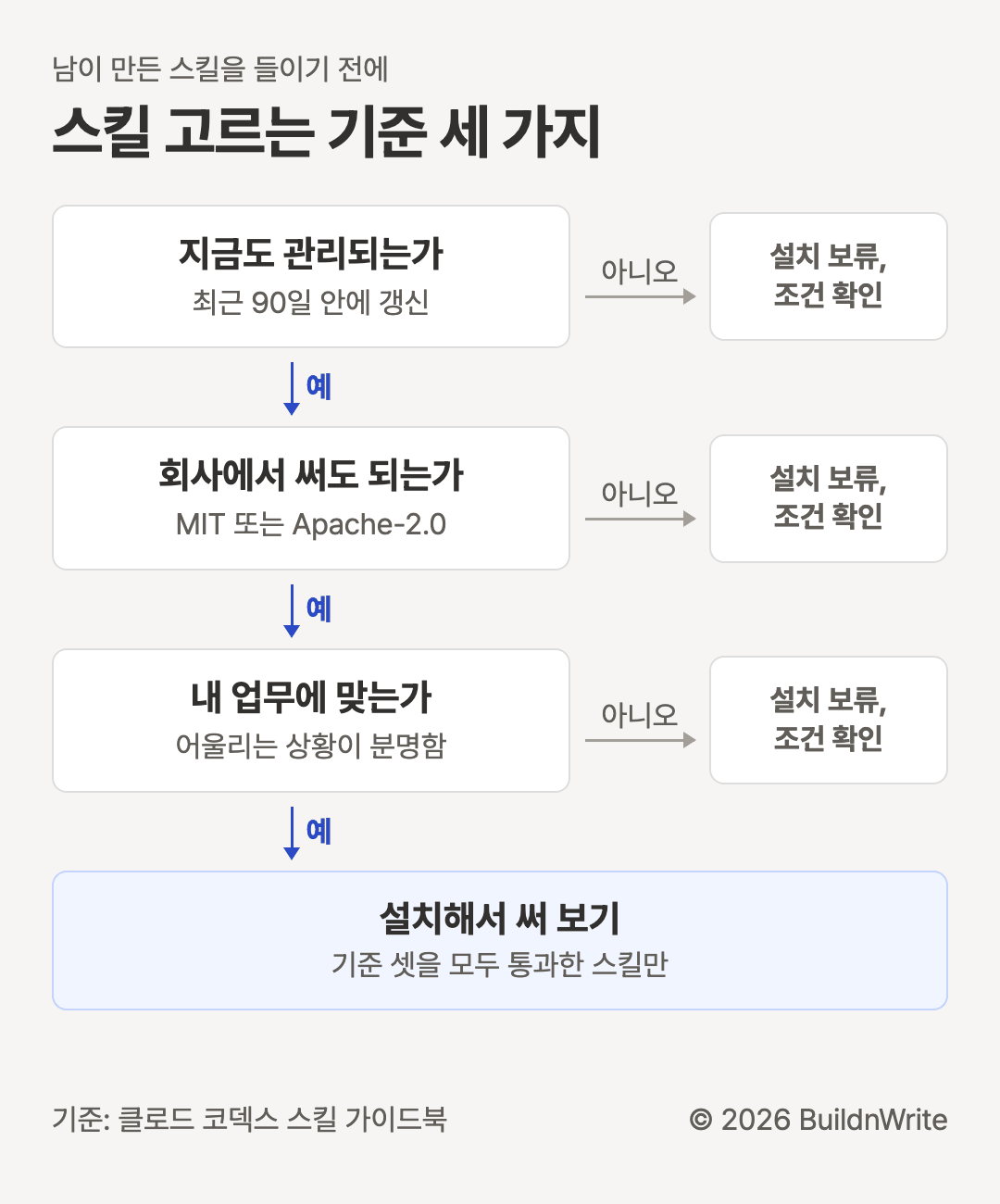
| Criterion | Where to check |
|---|---|
| 1. Still maintained | Date of the last commit on the GitHub repository home page |
| 2. Usable at work | License line in the About section on the right of the repository home page |
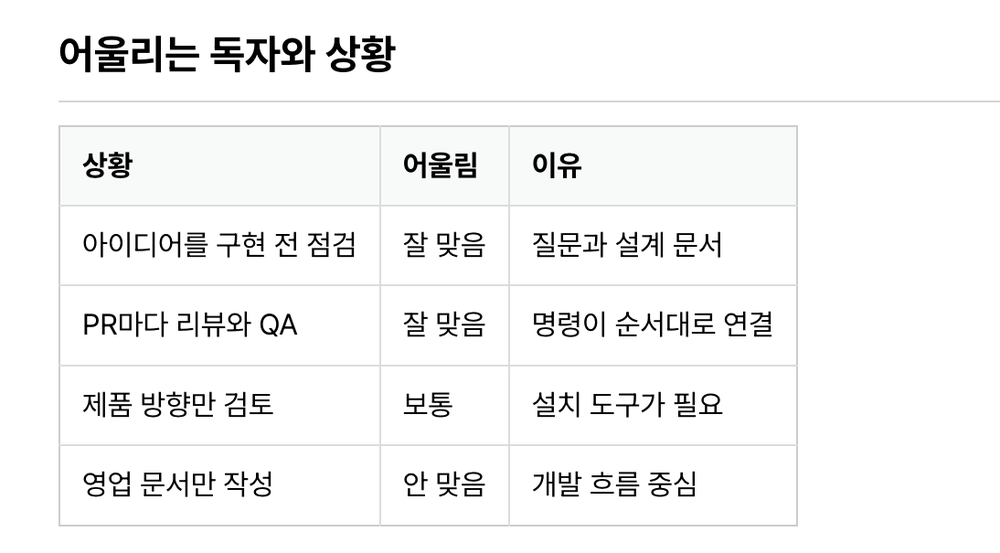
| 3. Clear fit for a situation | Target readers and situations table in each guidebook chapter |
Criteria 1 and 2 can be settled on the repository home page alone. A commit is a record of changes pushed to the repository, so the last commit date shows when it was last touched. Star count is only a reference for how well known the repository is.
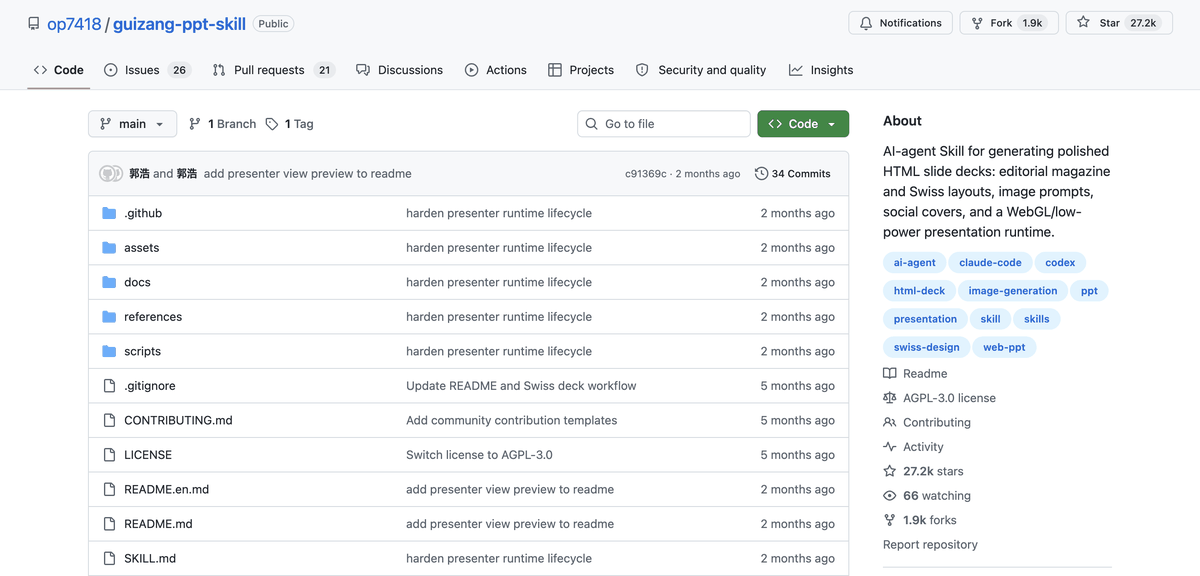
The repository in the screenshot is AGPL-3.0. AGPL-3.0 can carry a source-disclosure obligation if you modify it or offer it as a service, so at a company, the person in charge has to confirm it first.
The official docs explain why you must read a skill yourself before installing it:
- Skills can bundle and run scripts.
- Skills can grant broad tool permissions on their own, so the docs advise reviewing the allowed-tools (the list of tools a skill can use without asking) in a repository’s skill before running it.
- SKILL.md has a license field, but Claude Code only receives that value and does not act on it.
Criterion 3 doesn’t appear on the repository page. So the guidebook, published on Wikidocs (a Korean free book-publishing platform), has a table of the same form for each skill. Below is the table from the gstack chapter.
4. Popular Repositories I Did Not Include
These are popular repositories with many stars that were also recently updated, but I didn’t include them in the book. This is not a quality assessment. It’s a split based on the book’s license criteria. Figures are from GitHub as of October 2, 2026.
| Repository | Stars | License | Last commit (Korea Standard Time) |
|---|---|---|---|
| op7418/guizang-ppt-skill | 27,163 | AGPL-3.0 | August 7, 2026 |
| mksglu/context-mode | 24,796 | Elastic License 2.0 (GitHub displays it as Other) | October 2, 2026 |
- Both have commits within the last 90 days, so they pass the update criterion.
- Both have a license, but it falls outside the book’s allowlist (MIT, Apache-2.0).
- These are repositories to hold off on installing on a company computer until the license terms are checked.
5. The 56 Skills Included in the Guidebook
I bundled the skills I selected into 〈Claude Codex Skill Guidebook〉, published on Wikidocs on September 17, 2026. I applied the three criteria to 30 skills from external repositories. For the 26 skills I build and use myself, I included only the ones I actually use.
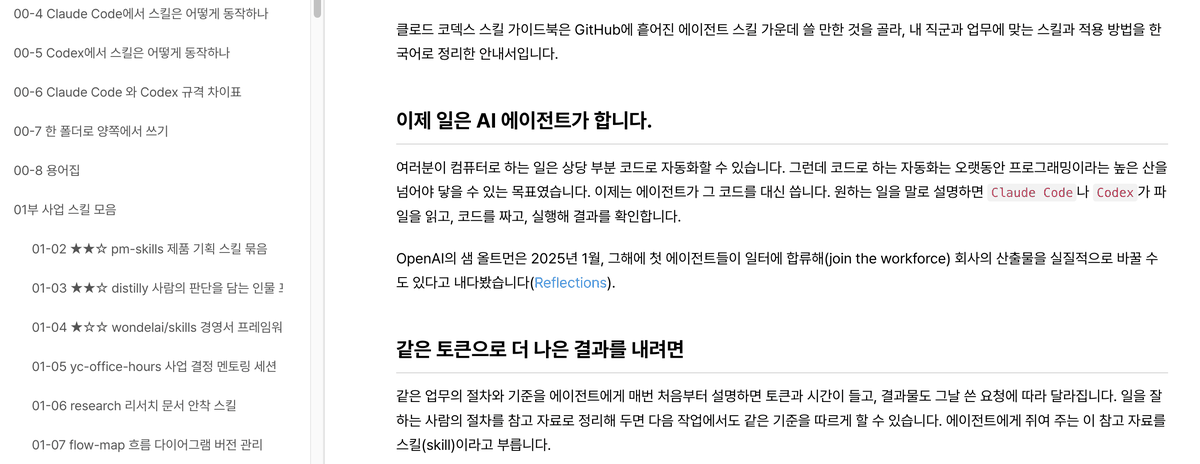
As of the table of contents on October 2, 2026, the book has 9 basic chapters and 56 skill chapters across 8 parts.
| Part | Chapters | Chapter with the most stars (as of October 2) |
|---|---|---|
| 01 Business | 7 | pm-skills product planning, 26,720 |
| 02 Marketing | 9 | humanizer writing style correction, 53,407 |
| 03 Data analysis | 5 | last30days-skill research on public opinion over the last 30 days, 63,355 |
| 04 Design | 7 | archify system structure diagrams, 75,851 |
| 05 Development | 6 | superpowers development methodology, 293,999 |
| 06 Operations automation | 7 | obsidian-skills Obsidian work, 49,077 |
| 07 Working with agents | 8 | grilling plan verification questions, 273,949 |
| 08 Vibe coding | 7 | ponytail preventing over-implementation, 150,581 |
- The web serial is free in full. The e-book is sold separately.
- All 30 external skills have commits within the last 90 days and use an MIT or Apache-2.0 license. Stars serve as a reference baseline (10,000 for development and data analysis, 2,000 for the rest), and three fall below it.
- The stars next to the chapter titles in the table of contents are a shorthand for each repository’s star count. Three are 50,000 or more, two are 10,000 or more, and one is below that. They do not guarantee quality.
- At publication the book had 50 skills. It has since grown to 56.
- In the first week after publication, it ranked third on the Wikidocs weekly best list, with 12,738 weekly views.
6. How I Re-Select Every Week
Skill repositories keep appearing every week. So I scan the candidates each week using the same criteria, and post the results on the book’s Weekly Skill Radar page.
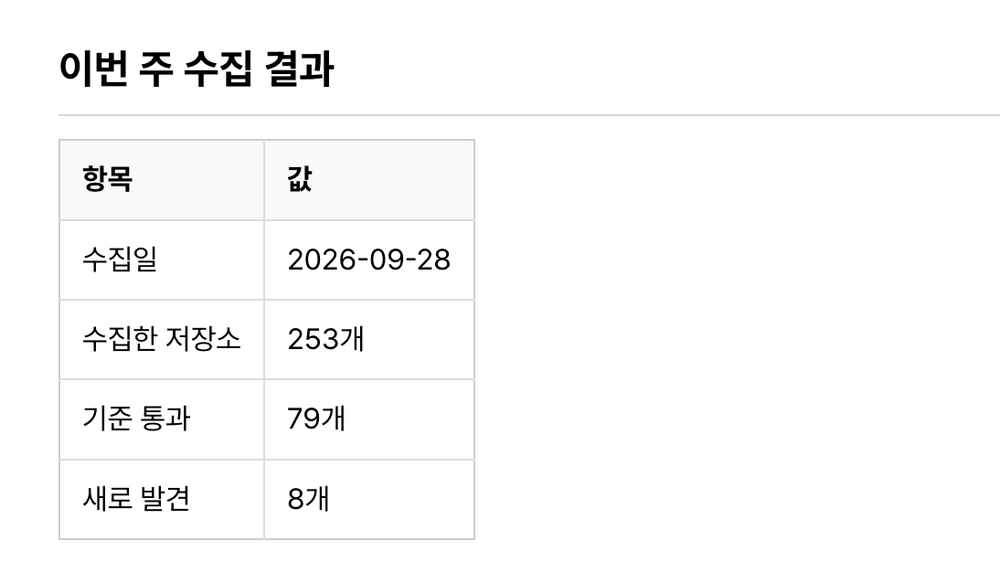
- The radar filters automatically on the star baseline, commits within the last 90 days, and an MIT or Apache-2.0 license.
- A list that passes is only a set of candidates for chapters in the main text. Only skills I have run directly on both Claude Code and Codex move into main-text chapters.
- Criterion 3, meaning whether the situation fits the skill, is judged by a person filling in the table.
7. When Choosing Skills for a Team
A skill is a file that records the steps a team follows in its work. The team knows best how each task should be handled and by what criteria. So when the three criteria above are carried over to a team, they become these questions:
- Who checks the license and the last update date when bringing in an external skill?
- Who reads the SKILL.md, the scripts, and the allowed-tools before installation?
- Which repeated tasks with a fixed procedure in our work are candidates for skills?
- When do we count whether the skills we’ve built are actually being used?
The guidebook’s SkillSpector chapter covers how to hand pre-installation checks to a tool.
Frequently asked questions
- What is a Claude skill?
- It is an instruction manual an agent pulls out when it needs it. You write the procedure in a SKILL.md file inside a folder. Claude uses it on its own when a request is relevant, or a person can call it by name. Codex and other agents read the same format.
- What should I use to choose a Claude skill?
- Three things: whether it was updated in the last 90 days, whether its license, such as MIT or Apache-2.0, allows company use, and whether your work fits the situation it's for. You can check the first two on the GitHub repository home page.
- Can I install a skill someone else made on a company computer?
- Treat it the same as installing a program, because a skill feeds instructions to an agent and makes it run scripts. Before installing, check the license, then read the SKILL.md, the bundled scripts, and the allowed-tools settings.
BuildnWrite helps teams build AI agents that keep running. About BuildnWrite ›