What Is AI Hallucination? Why Plausible Answers Are Wrong and How to Check
Who this is forOffice workers who already use AI at work, and the adoption and training leads preparing AI training for their employees.
Series · AI automation glossary part 14 of 14, expand to see all
- What Is an API? Understanding It with One Snack Bar Order Slip
- What Is a Webhook? Understanding It With a Restaurant Waiting Ticket
- What Is a Server? A Computer That Stays On When Yours Doesn't
- What is a terminal? A plain-English guide to the CLI and shell
- AI automation terms explained: MCP, agent, context, skill, and secret
- Claude terms explained: Projects, Artifacts, Cowork, and scheduled tasks
- What Is a Database? Why Tables Look Alike but Lock Differently
- What Is Supabase? Tables, Auth, and Server Functions in One Place
- Auth and RLS Explained: Keep the Screen Open, Lock the Data
- What Is Google Apps Script? Running Your Code on Google's Servers
- What Is Playwright? Why AI Suddenly Opens a Chrome Window
- What Is Aside? An Agent Browser That Clicks Using Your Own Logins
- What Does AX Mean? AI Transformation vs. DX and 3 Workplace Bottlenecks
- What Is AI Hallucination? Why Plausible Answers Are Wrong and How to Check
TL;DR: Hallucination is when an AI confidently gives a plausible answer that is not true. A large part of the cause is that guessing has been rewarded over saying “I don’t know.” So after you get an answer, ask for the supporting sentence, check it against the original, and verify it with another tool.
Contents
- What Is Hallucination: Plausible but Wrong Answers
- Why It Happens: Guessing Gets Rewarded
- What I Saw in Training: The Blocker Was Verification
- Follow-Up Questions to Ask Right After the Answer
- Double-Checking with Another Tool
- If You Are Preparing AI Training: One Pre-Survey Question
- Summary
1. What Is Hallucination: Plausible but Wrong Answers
You have probably asked an AI something, received an answer with smooth sentences and a confident tone, and later found it was wrong. This phenomenon is called hallucination. This article explains what the word means and what to check after you get an answer.
- OpenAI, in its post Why language models hallucinate, describes hallucination as plausible but incorrect statements generated by language models. The Korean edition of the same post renders this term as “hwangak.”
- Anthropic’s Claude documentation says that even the most advanced language models sometimes produce text that is false or conflicts with the material they were given, and calls this hallucination.
The one word both explanations share is “plausible.” A wrong answer that looks wrong is not the problem. The problem is that it comes out in the same tone as a correct one, which makes it hard to pick out.
2. Why It Happens: Guessing Gets Rewarded
The same OpenAI post explains the cause in two parts.
First, evaluation methods reward guessing. OpenAI explains that current training and evaluation methods score guessing higher than admitting “I don’t know.” Compared to a multiple-choice test, it looks like this:
| Situation | If you guess | If you leave it blank |
|---|---|---|
| Multiple-choice test, you don’t know the answer | A lucky guess earns the point | 0 points |
| Asked someone’s birthday, you don’t know it | Naming one date gives a 1-in-365 chance of being right | Saying “I don’t know” gets 0 points |
| Grading thousands of questions this way | The guessing model scores higher | The careful model scores lower |
If grading only counts correct answers, a model that guesses when unsure wins. OpenAI argues that evaluation should instead penalize confident wrong answers more heavily and give partial credit when a model honestly says it doesn’t know.
Second, rare facts cannot be matched by pattern. Language models learn by practicing predicting the next word across large amounts of text. OpenAI explains that rules that stay consistent, like spelling or matching parentheses, are almost never wrong. But facts with no fixed rule that appear rarely, like the birth date of an animal, cannot be matched by pattern alone, which leads to hallucination.
3. What I Saw in Training: The Blocker Was Verification
Knowing the principle is one thing. The real bottleneck in daily work is somewhere else. Complaints from participants before training showed where. The answers looked plausible but had no grounding attached, so every time someone doubted one, they had to track down the source themselves, which took even more time.
So the training plan did not separate learning how to ask questions from learning to doubt answers. It tied them into one flow: ask, then verify right away.
4. Follow-Up Questions to Ask Right After the Answer
You don’t need to invent new verification questions. AI companies have written down reduction methods in their official documentation. Claude’s documentation puts three basic methods first.
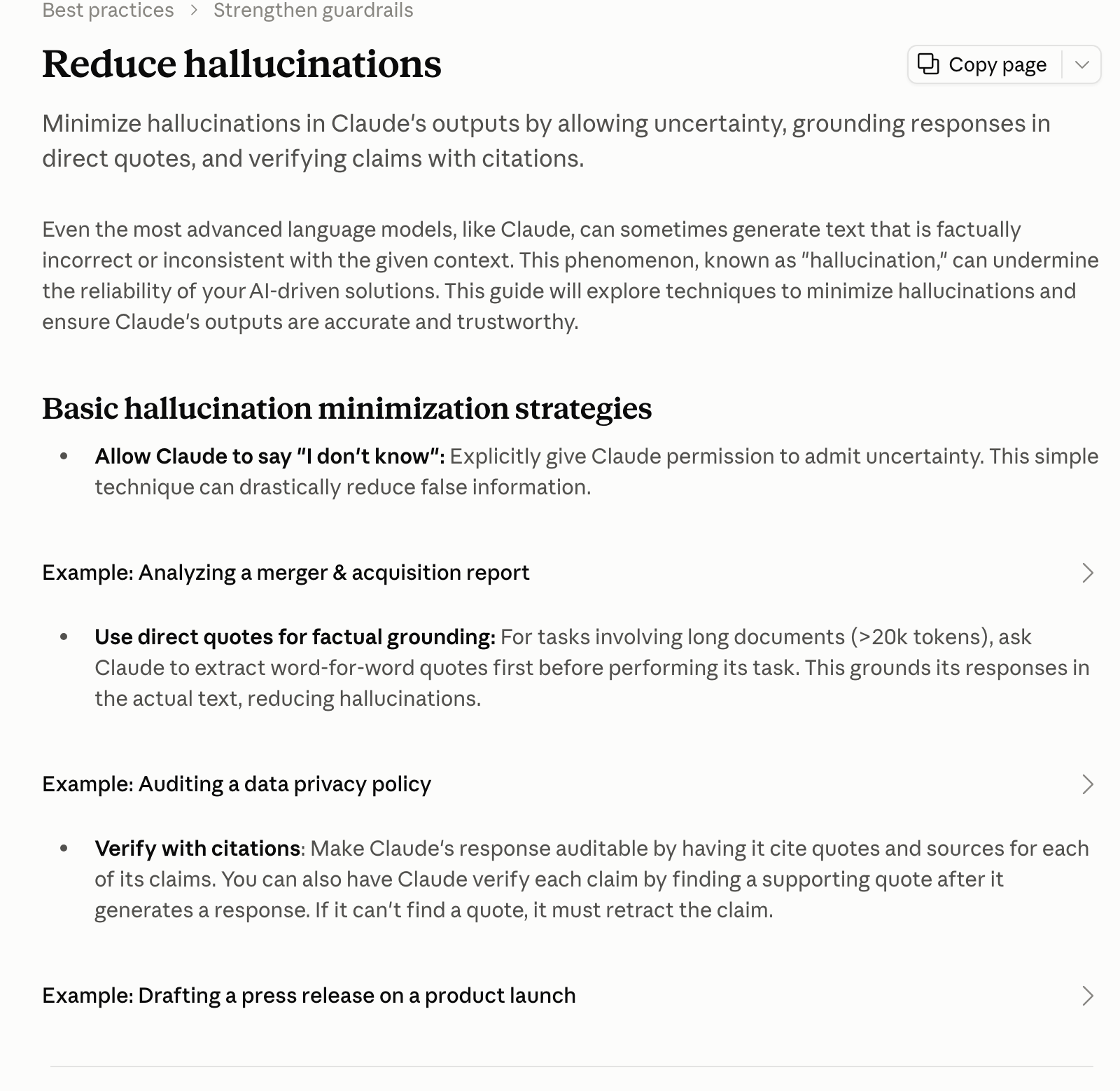
This document is a guide for developers who attach AI to their own services. The table below turns those recommendations into questions you can use directly in a chat window. The first row is a question I included in the training materials.
| What to ask | What it catches | Basis |
|---|---|---|
| “Show me the source and the supporting sentence for this answer” | Claims made up without grounding | Training material; Claude docs (verify with citations) |
| “It’s fine to say you don’t know” (ask this along with your question) | Guesses on things it doesn’t know | Claude docs (allow saying “I don’t know”) |
| “Please rewrite this, dropping any claim you can’t find a supporting sentence for” | Sentences that don’t match the evidence | Claude docs (withdraw claims when no quote is found) |
| “Answer only from the material I pasted” | Content pulled from outside the material | Claude docs (limit to external knowledge) |
| Ask again in a new chat and compare | Answers that change each time you ask | Claude docs (run multiple times and compare) |
- When pasting a long document and asking questions, follow the Claude documentation’s advice: first have the AI pull the relevant sentences word for word, then have it answer based on those sentences.
- If the same question gets different answers each time, the Claude documentation treats that as a signal to suspect hallucination.
5. Double-Checking with Another Tool
After you get supporting sentences, the next step is checking them against the original. In training, I included a method for confirming with another tool whether the original really says the same thing. Adding the official documentation’s recommendations, the verification order is summarized below.
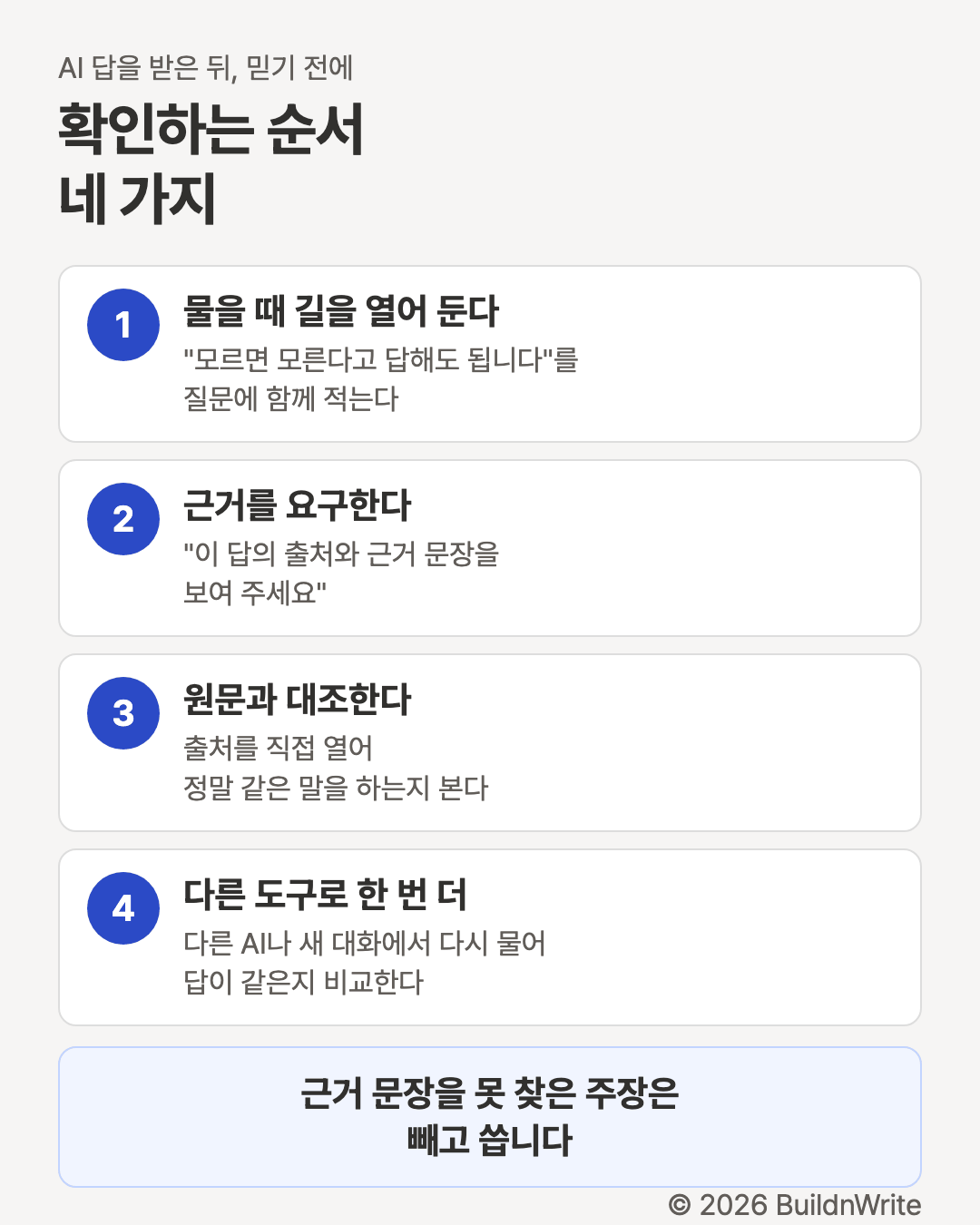
The point where two answers disagree is where to look again. Matching answers do not guarantee correctness, so check the original for anything important. The Claude documentation also notes that these methods greatly reduce hallucinations but do not eliminate them, and it advises checking important judgments directly.
6. If You Are Preparing AI Training: One Pre-Survey Question
If your company already has employees using AI, the next training may need to cover how to verify answers rather than how to use the tool.
So if you are preparing training, consider adding one item to your pre-training survey: “How do you check AI answers?”
To see where your company’s AI adoption stands, read AX meaning and the three bottlenecks in a company. For the line between what you can do alone and what needs outside help, continue with 3 self-check questions before adoption.
7. Summary
Official documentation checked: October 5, 2026. Sources: OpenAI, Why language models hallucinate (published September 5, 2025), and Anthropic, Claude documentation: Reduce hallucinations.
Frequently asked questions
- What does hallucination mean?
- An AI confidently gives an answer that sounds plausible but is not true. OpenAI calls these plausible but false statements from language models; the Korean edition translates the term as hwangak. Smooth wording and a confident tone make the error easy to miss.
- Can hallucinations be eliminated completely?
- The two companies differ slightly. Anthropic's Claude docs say these methods greatly reduce hallucinations but cannot eliminate them, so check important information directly. OpenAI says 100% accuracy is impossible, but models can abstain when unsure. Either way, your own checking remains.
- Don't newer or larger models make fewer mistakes?
- OpenAI says GPT-5 hallucinates much less, especially when reasoning, but still can. The same post notes smaller models may more easily recognize their limits, since they can simply say they don't know. Switching to a newer model does not remove the need to check.
Free 10-minute checklist: is your computer ready for a coding agent like Claude Code or Codex?. Get it free
BuildnWrite helps teams build AI agents that keep running. About BuildnWrite ›