3 Questions to Tell AI Agent Work You Can Do Alone From Work That Needs Coaching
Who this is forPractitioners who were assigned AI automation or agent adoption at their company and want to gauge whether they can push it alone or need outside help first.
TL;DR: AI agent adoption usually gets stuck outside the tool, not in it. Can you change the environment, can you name which errors cause real harm, and do you set the budget and deadline? If you answer yes to all three, start on your own. If the answer is no to the first or third, this is work to solve with your organization.
Contents
- Why start with these questions?
- Can I change the environment?
- Can I say which errors cause real harm?
- Do I set the budget and deadline?
- Decision table and next steps
1. Why start with these questions?
When I help people in charge of AI adoption at companies, they get stuck in similar places. Fixing a prompt or picking a tool doesn’t take long. What takes time is usually these things:
- You don’t have permission to install the tools you need under your work account.
- No one has checked which model is actually being called.
- What counts as “working well” changes midway through.
- The budget and deadline were already reported to upper management, but the person doing the work only learns the numbers later.
These constraints usually surface one at a time during the work. If you had asked before starting, they could have been built into the design from the start.
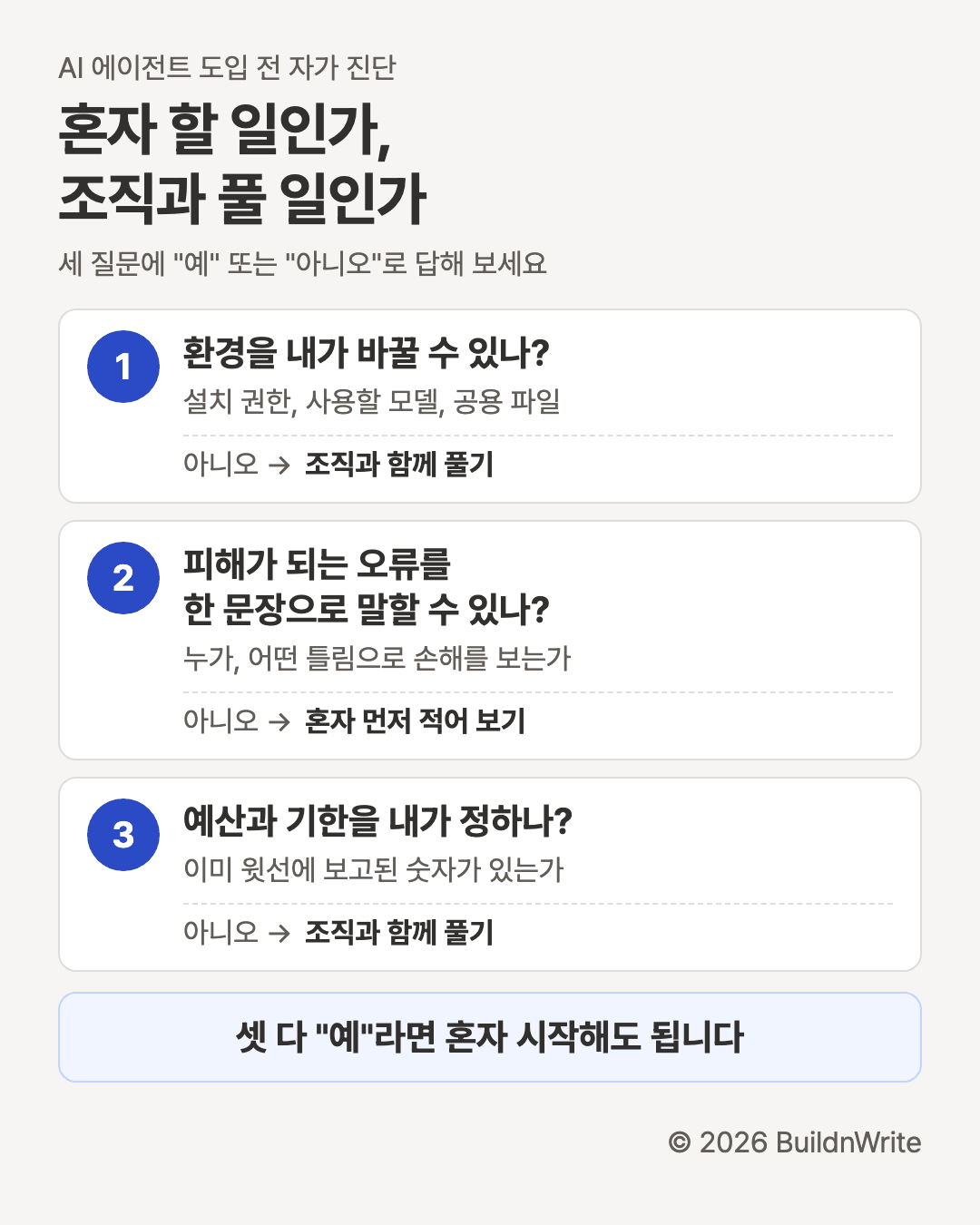
This article narrows the checks to be done before starting into three groups that the person in charge can answer alone. Before choosing a tool, try answering these three questions first.
2. Can I change the environment?
The first question is whether you control the place where the agent runs. Check these four things yourself.
- Can you install the programs you need under the account you work with?
- Do you know which model is being called right now, and where the default is written down?
- Has the company specified models or services you’re not allowed to use?
- Are there shared files or folders where changing something would affect other work?
In the field, these four often get blocked all at once. Without install permission you spend time looking for workarounds, and if you carelessly touch a shared file, other work stops. If the organization has no official route for requesting permission, the scope of possible solutions narrows from the start.
If you can change all four yourself, this question passes. If even one comes down to “I have to ask someone,” figuring out who that someone is comes first.
3. Can I say which errors cause real harm?
The second question is about success criteria. “Accurate” is not a criterion. You should be able to say in one sentence which mistakes cause real harm, and to whom.
A common mistake is measuring only how closely the AI’s results match human judgment. But if the output is not the final decision and is just source material for a person to review, the picture changes. An error a person will review anyway is not an accident. A real accident narrows to one case: a result that a person trusted and passed along was wrong. Rewrite the purpose and the metrics you need to measure change too.
So even if the answer to this question is “no,” you can start working through it alone. On paper, write down who will receive the output, what happens when it’s wrong, and one of those outcomes that can’t be undone.
4. Do I set the budget and deadline?
The third question is who owns the numbers.
- Have the budget and deadline for this work already been reported to upper management?
- If so, what basis were those numbers derived from?
- How large is the volume that has to be processed at once?
Many projects start with the budget already reported. Also, initial cost estimates are often made by running one item and multiplying by the full scale, so the numbers can differ when you actually run it. Once a reported number exists, reconciling it with measured results becomes a separate task.
5. Decision table and next steps
Match your answers to the three questions against the table.
| Question 1: environment | Question 2: error | Question 3: numbers | Verdict |
|---|---|---|---|
| Yes | Yes | Yes | Start on your own |
| Yes | No | Yes | Start on your own; write the success criteria first |
| No | Doesn’t matter | Doesn’t matter | Solve with the organization |
| Doesn’t matter | Doesn’t matter | No | Solve with the organization |
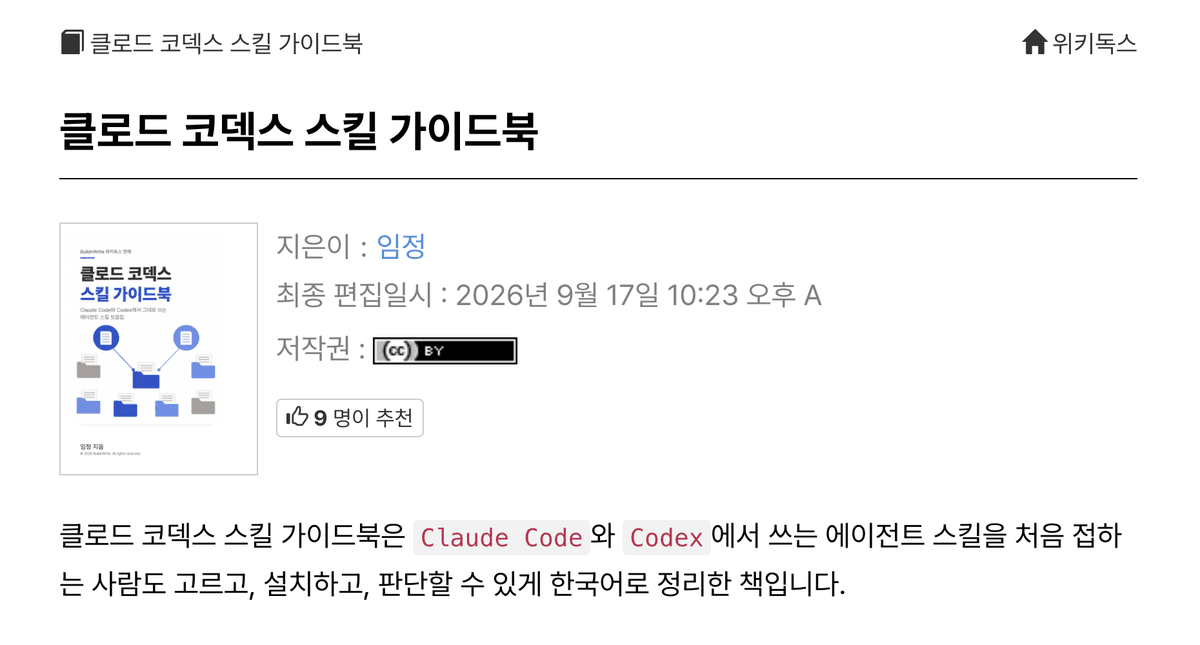
If you’re starting on your own, the next task is getting comfortable with the tools. There is a free book that helps people who are new to agent skills in Claude Code and Codex pick and install them.
If you need to work with your organization, sort out permissions, model policy, and the reported numbers before the tools. This part requires reviewing company circumstances together, so you can reach out directly from below this article.

If you’re wondering why automation doesn’t take root in a company even after repeated training, also read 4 stages for AI automation to settle into a company.
Frequently asked questions
- Why should I check the environment, error criteria, and budget before adopting AI agents?
- Adoption usually gets stuck outside the tool. Check whether you can change the environment, name which errors cause real harm, and whether you set the budget and deadline before starting.
- What should I do if I cannot change the environment or set the budget and deadline?
- Solve it with your organization first. If you answer no to the environment or budget question, the post recommends working through permissions, model policy, and reported numbers before choosing tools.
BuildnWrite helps teams build AI agents that keep running. About BuildnWrite ›