How to Use Free AI Models on OpenRouter: Sign-Up to Daily Limits
Who this is forReaders who want to try AI in automations or small tools but want to test it for free before paying for API usage.
TL;DR: GPT, Claude, and Gemini APIs cost more the more you use them. On OpenRouter, models whose names end in
:freecost $0. The trade-off is a daily request limit, and depending on the model, what you enter may be used for training.
Contents
- AI APIs cost more the more you use them
- OpenRouter: one key for models from many companies
- Two ways to choose a free model
- Getting a key and making your first call
- Free limits: 50 and 1,000 per day
- When the free tier falls short: DeepSeek
- Models to avoid for work involving personal data
1. AI APIs cost more the more you use them
Using AI in a chat window and attaching AI to your own tools are billed differently. To attach AI to a tool, you use an API, and the API charges by the number of tokens every time you call it.
Here are the prices for major models. They are in dollars per 1 million tokens, as of September 17, 2026, from OpenRouter’s model pages. OpenRouter says it passes through the providers’ prices as they are.
| Company | Model | Input | Output |
|---|---|---|---|
| OpenAI | GPT-6 Astra | $10 | $50 |
| OpenAI | GPT-5.6 Sol | $2 | $10 |
| Anthropic | Claude Opus 5 | $5 | $25 |
| Anthropic | Claude Sonnet 5 | $2 | $10 |
| Gemini 3.1 Pro Preview | $2 | $12 | |
| Gemini 3.8 Flash | $0.75 | $3.75 | |
| OpenRouter | Any model whose name ends in :free |
$0 | $0 |
Prices per million tokens are hard to picture, so while writing this article I calculated the monthly cost based on one actual call. It was a call that gave the model one sentence and asked it to point out an awkward expression. It used 56 input tokens and 729 output tokens.
Running a sentence check 1,000 times a day costs up to $1,110 a month
30-day cost in dollars. Each call assumes 56 input tokens and 729 output tokens
Source: OpenRouter per-model pricing page (checked September 17, 2026), author's calculations
2. OpenRouter: one key for models from many companies

OpenRouter is a gateway that lets you call AI models from many companies in one place. You don’t need to sign up and pay separately for OpenAI, Anthropic, and Google models. With one OpenRouter key, you just change the model name to switch between them.
For people who want to use AI for free, there is one more important point. OpenRouter keeps a collection of free models that cost $0. You can see which models are available right now on the free models collection page that OpenRouter runs.
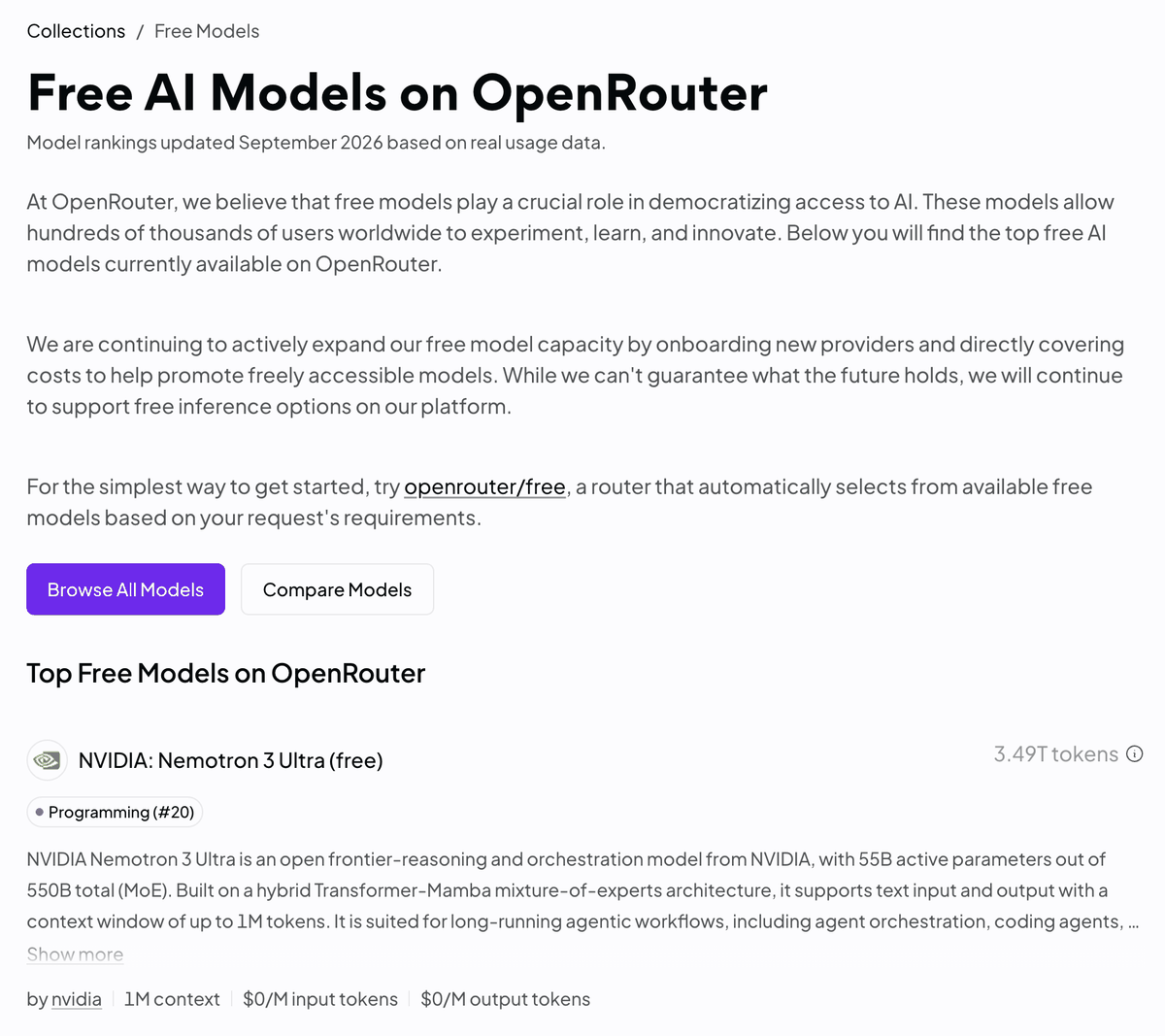
The collection page ranks models by actual usage, and the screenshot I captured is labeled as of September 2026. So this article doesn’t recommend a specific model. Instead, it covers how to choose a model that will still work no matter which ones show up.
3. Two ways to choose a free model
| Method | Model name to use | When it fits |
|---|---|---|
| Pick one yourself | A model whose name ends in :free |
You already know which model you want |
| Automatic selection | openrouter/free |
Any free model is fine |
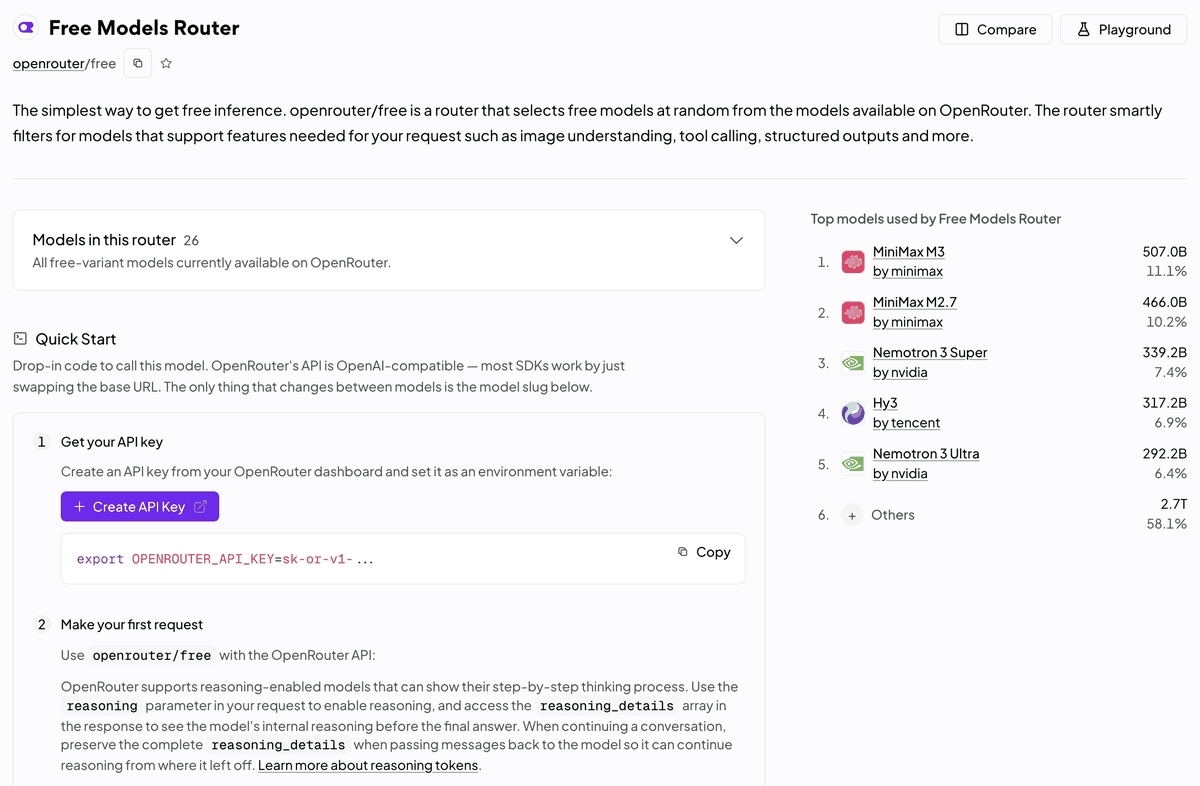
openrouter/free picks one of the currently available free models at random. It narrows the choice to models that support the features your request needs, such as image understanding or tool calling.
4. Getting a key and making your first call
Follow these steps in order.
- On the OpenRouter site, click Sign Up in the upper right, then log in.
- In the left-hand list, click API Keys.
- Click New Key in the upper right to create a key, then copy the value.
- In your terminal, save the key as an environment variable (a named value stored in your computer).
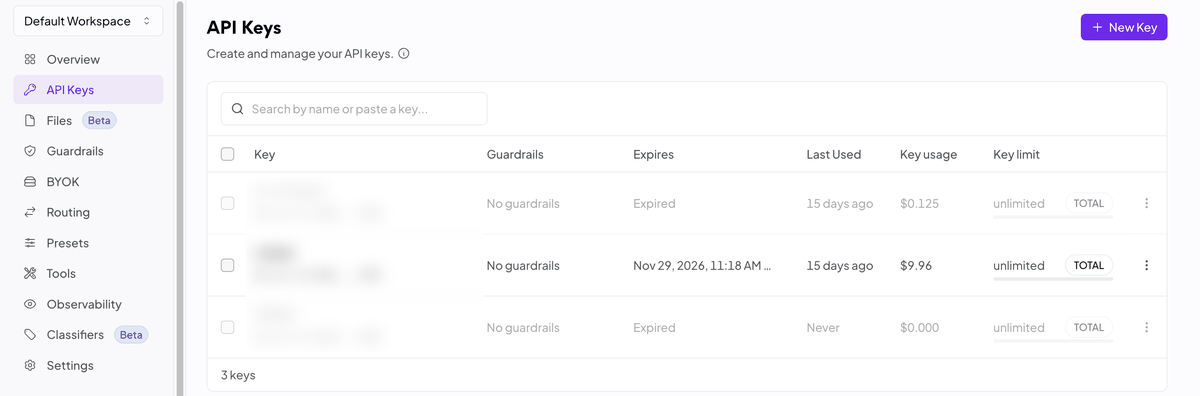
export OPENROUTER_API_KEY=sk-or-v1-...This command is for macOS and Linux. The saved value only lasts in that terminal window.
Now let’s ask the free router to check a sentence once.
curl https://openrouter.ai/api/v1/chat/completions \
  -H "Authorization: Bearer $OPENROUTER_API_KEY" \
  -H "Content-Type: application/json" \
  -d '{
    "model": "openrouter/free",
    "messages": [
      {"role": "user", "content": "다음 문장에서 어색한 표현 하나만 짚어줘: 이 기능은 매우 유용하게 활용될 수 있는 부분이라고 할 수 있습니다."}
    ]
  }'
When I made this call on September 17, 2026, the key fields in the response were as follows. The answer came back in about 3 seconds.
| Response field | Value |
|---|---|
model (the model that answered) |
inclusionai/ling-3.0-flash-fin:free |
usage.cost (price) |
0 |
| Gist of the answer | A suggestion to replace the awkward word “part” with “aspect” or “element” |
The OpenRouter API uses the same format as the OpenAI API. According to OpenRouter’s documentation, most OpenAI libraries that your program uses to call AI work just by changing the base URL. In that case, enter your OpenRouter key and an OpenRouter model name.
5. Free limits: 50 and 1,000 per day
Free models have request limits. According to the OpenRouter limits documentation, the limits are based on the total credits you have purchased so far. Credits are a prepaid balance that you add in advance from Credits in the left-hand list, and a fee is added when you buy them.
| Credits purchased (cumulative) | Per minute | Per day |
|---|---|---|
| Under 10 credits | 20 requests | 50 requests |
| 10 credits or more | 20 requests | 1,000 requests |
- The limit applies to your whole account, not to each model. Creating more keys doesn’t raise it.
- A day is counted in UTC, so it resets at 9:00 a.m. Korea Standard Time (KST, which is UTC+9).
- The documentation says the higher limit starts at 9 credits, to account for the top-up fee.
You can check how many requests you have left on your account by querying your key info.
curl https://openrouter.ai/api/v1/key \
  -H "Authorization: Bearer $OPENROUTER_API_KEY"
The response’s free_model_daily_requests field shows the number used today (used), the number remaining (remaining), and the daily limit (limit). On my account, which has purchased credits before, limit was 1000.
Keep in mind that the daily count applies to your account, so switching to another model doesn’t raise the limit.
6. When the free tier falls short: DeepSeek
If 1,000 requests a day isn’t enough, or you need a more stable model, move to a paid model. The first place to look is the DeepSeek models page. If you calculate using the same call as in Section 1, the difference is striking.
DeepSeek costs about 1/17 of Claude Sonnet 5
30-day cost in dollars at 1,000 calls a day. Calculated with the same token counts as in Section 1
Source: OpenRouter per-model pricing page (checked September 17, 2026), author's calculations. DeepSeek V4.1 Flash is $0.15 input, $0.60 output
7. Models to avoid for work involving personal data
Free use may come at a cost. The description of Laguna S 2.1 on the free models collection page says that if you use it for free, your inputs and outputs may be used to improve the model. The Privacy settings in your account also have a switch for choosing this.
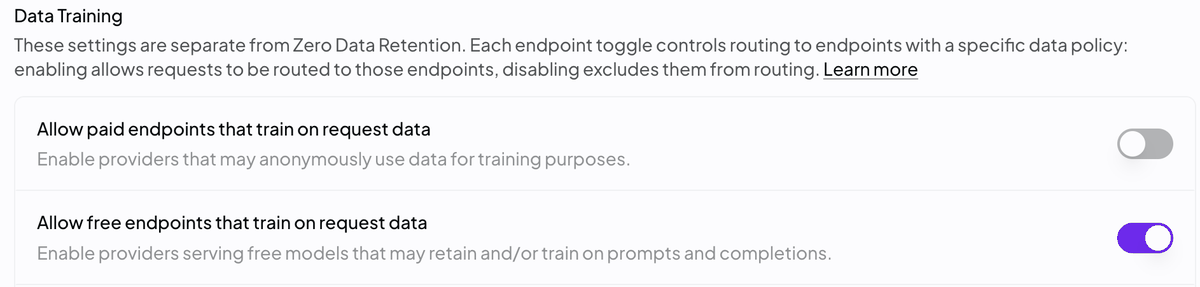
- If you turn off the second switch, Allow free endpoints that train on request data, your requests won’t be sent to free providers that may store or train on your inputs.
- In the screen’s description, the subject is the provider (the company that runs the model on its servers), not the model. Naming a model fixes which company made it, but the provider that handles your request is chosen separately.
The companies that make the models also need separate attention. Three of the top 5 models by token share on the router screen in Section 3 were from MiniMax and Tencent, both Chinese companies. DeepSeek in Section 6 is also a Chinese company. If you use openrouter/free, you can’t choose which company’s model will answer.
Here’s a summary by situation.
| Situation | Choice |
|---|---|
| Trying it for the first time | openrouter/free |
| More than 50 requests a day | Add 10 credits, for 1,000 requests a day |
| Free isn’t enough, and cost matters | A paid DeepSeek model |
| Work involving personal data | Turn off the training switch, and name the model yourself without Chinese-company models |
Frequently asked questions
- Do OpenRouter models whose names end in :free cost anything to use?
- Yes. Models whose names end in :free are priced at $0 for both input and output. Free models still have a daily request limit.
- What is the daily request limit for free OpenRouter models?
- The post lists 50 and 1,000 requests per day. According to OpenRouter's documentation, the limits are based on the total credits you have purchased so far.
Want the full system? The Claude Code & Codex Skills guidebook collects the skills and subagents behind this blog, from $19.
BuildnWrite helps teams build AI agents that keep running. About BuildnWrite ›