Could Aside Become the Second Cursor? An AI Browser Built on Chromium
Who this is forFor readers who have heard of Aside and want a clear picture of how it differs from Chrome or Playwright, and why AI browsers rise and fall so quickly.
TL;DR: Browsers’ insides have converged on one engine, Chromium, and browser automation has spent 20 years moving in one direction: outside code drives the browser inside. Aside is a browser made by copying and modifying Chromium, and it reversed that direction. An agent lives inside the browser, and the browser opens itself to the outside through a CLI and MCP. It has the same structure as Cursor, which grew from a modified copy of VS Code, but in 2026, the year Aside launched, OpenAI’s browser shut down less than a year after release. This article charts that lineage with screenshots from the app itself and lays out the criteria for answering “Could it become the second Cursor?”
Contents
- What is Aside?
- In the Beginning Was the Chromium Engine
- The Automation Stages: From Selenium to Playwright
- Aside Reversed That Direction
- Could Aside Become the Second Cursor?
- Summary
1. What is Aside?
Aside is a macOS browser that introduces itself as “the most intelligent AI assistant, but it’s a browser.” Inside sites you’re already logged into, an agent reads the screen and clicks on your behalf. I covered the concept in the What is Aside? explainer, so this article looks at the company and its lineage.
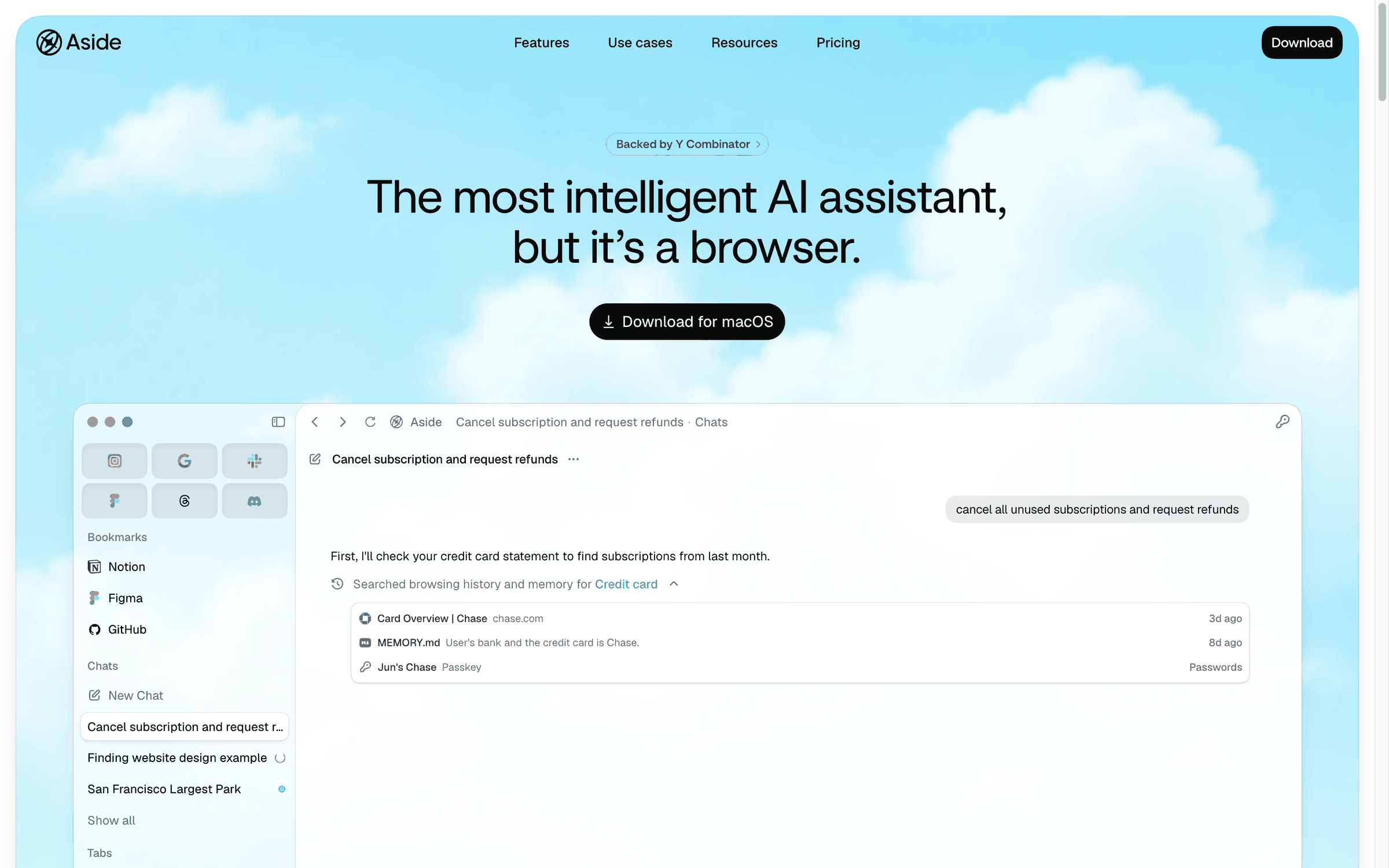
The company information is on the Y Combinator official page.
| Item | Details | Source |
|---|---|---|
| Company | San Francisco. The homepage copyright notice reads Aside Computer Inc.; the browser build’s copyright notice reads At Your Side Inc. | Y Combinator, aside.com footer, version screen below |
| Founded | 2024; Y Combinator Fall 2025 batch | Same page |
| Founders | Jun Kim (CEO), Chanhee Lee (CPO), Sanghun Lee (CTO); all three are from South Korea | YC page, eomag interview |
| Team | 5 people | YC page |
| Launch | June 23, 2026; the launch post drew 1.6 million views | eomag interview |
| Foundation | Copied and modified Chromium (internal name Bromium), Chromium 152 | Interview, measured screen below |
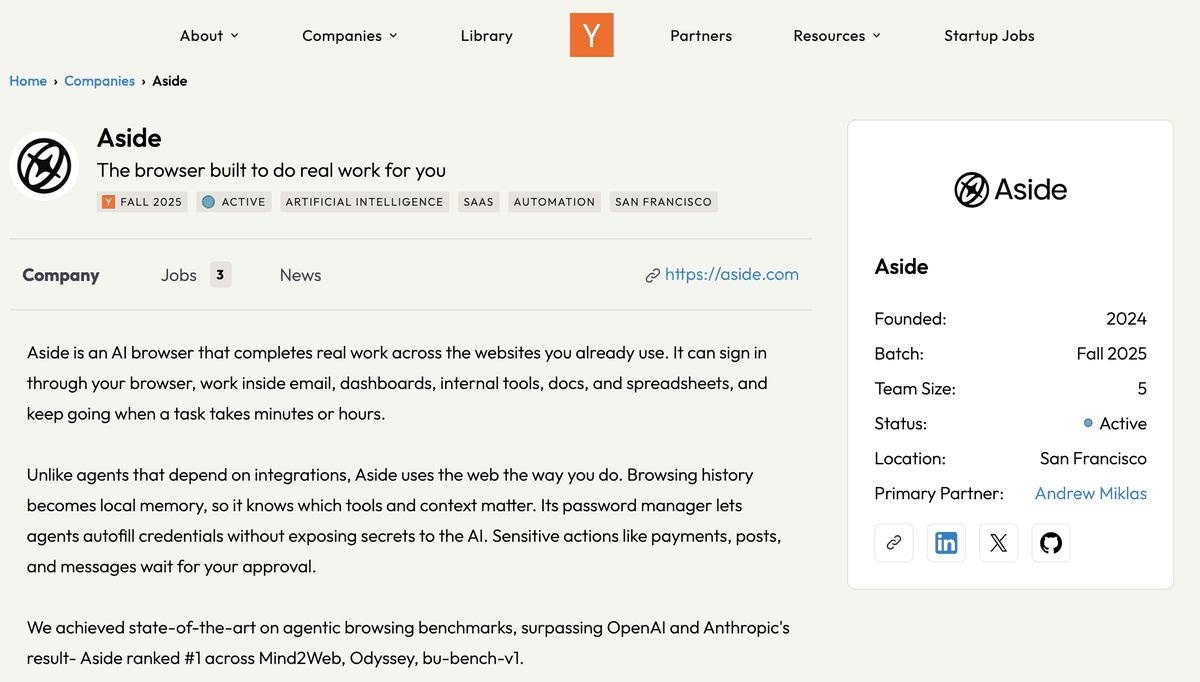
In the interview, cofounder Chanhee Lee says he got into YC on his seventh application. After the batch ended with no results, he spent two months in a state of not wanting to write a single line of code. In January 2026 the CEO proposed an AI browser, and the product launched five months later is today’s Aside.
2. In the Beginning Was the Chromium Engine
To understand Aside, you first need to know what “building a new browser” means in 2026. The answer is simple: nobody builds a browser from scratch anymore. They take Chromium, which Google has released publicly, and use it.
Chromium is a browser’s insides. In car terms, it’s the engine and frame. Companies attach different exteriors (colors, button placement, names), but the part that reads web pages and draws them on screen is the same. That’s why Chrome, Edge, Naver Whale (Naver’s browser), and Samsung Internet look different in name yet show the same pages almost identically.
| Exterior (browser name) | Engine underneath | Worldwide share, August 2026 |
|---|---|---|
| Chrome, Edge, Samsung Internet, Opera, Naver Whale (Naver’s browser), Brave, Vivaldi, Arc | Chromium | About 79% (sum of only the four largest listed here) |
| Safari | Apple WebKit | About 16% |
| Firefox | Mozilla Gecko | About 3% |
The share figures come from StatCounter, August 2026. Roughly eight out of ten people use browsers whose engine is Chromium.
Browsers aren’t the only case. Many desktop apps also have Chromium underneath:
- VS Code (the app programmers write code in)
- Slack, Discord (messaging apps)
- GitHub Desktop
These apps are built with a method called Electron, which embeds Chromium inside the app so you can build desktop apps the way you’d build web pages. Since anyone who can make a website can make a desktop app, many companies took this route.
So in 2026, “building a new browser” means “copying Chromium and modifying it.” Aside was built that way too, and you can see the evidence right inside Aside.

3. The Automation Stages: From Selenium to Playwright
For over 20 years, making code move a browser on a person’s behalf has developed in one direction: outside code drives the browser inside.
20 years of browser automation: outside code drives the browser inside
Here are the years and sources.
| Tool | Started | Built by | What it changed | Source |
|---|---|---|---|---|
| Selenium | 2004 | ThoughtWorks, Jason Huggins | Turned browser testing into code | Wikipedia |
| WebDriver | Joined 2009, standard 2018 | Simon Stewart; the international standards body W3C | Replaced different control methods per browser with one standard | Same document |
| Puppeteer | 2017 | Google’s Chrome team | Drove Chrome running without a screen through the official channel | InfoQ 2017 |
| Playwright | January 2020 | Microsoft, former Puppeteer team | Chrome, Firefox, and Safari-family browsers in one approach | Wikipedia |
The direction held in the AI agent era too:
- Claude Code and Cursor attach servers such as Playwright MCP to drive the browser from outside.
- The browser remains a tool, and the outside agent makes the decisions.
- For someone seeing this scene for the first time, the article is What is Playwright?.
4. Aside Reversed That Direction
One day while using Aside, I came across this summary on Threads:
It’s simply a Chromium fork that makes the browser, which people used to hook up to AI CLIs, IDEs, and the like via MCP, connectable in reverse from the browser itself.
(Threads, anonymous user)
It’s a single line, but it’s accurate. Checking it against the official docs:
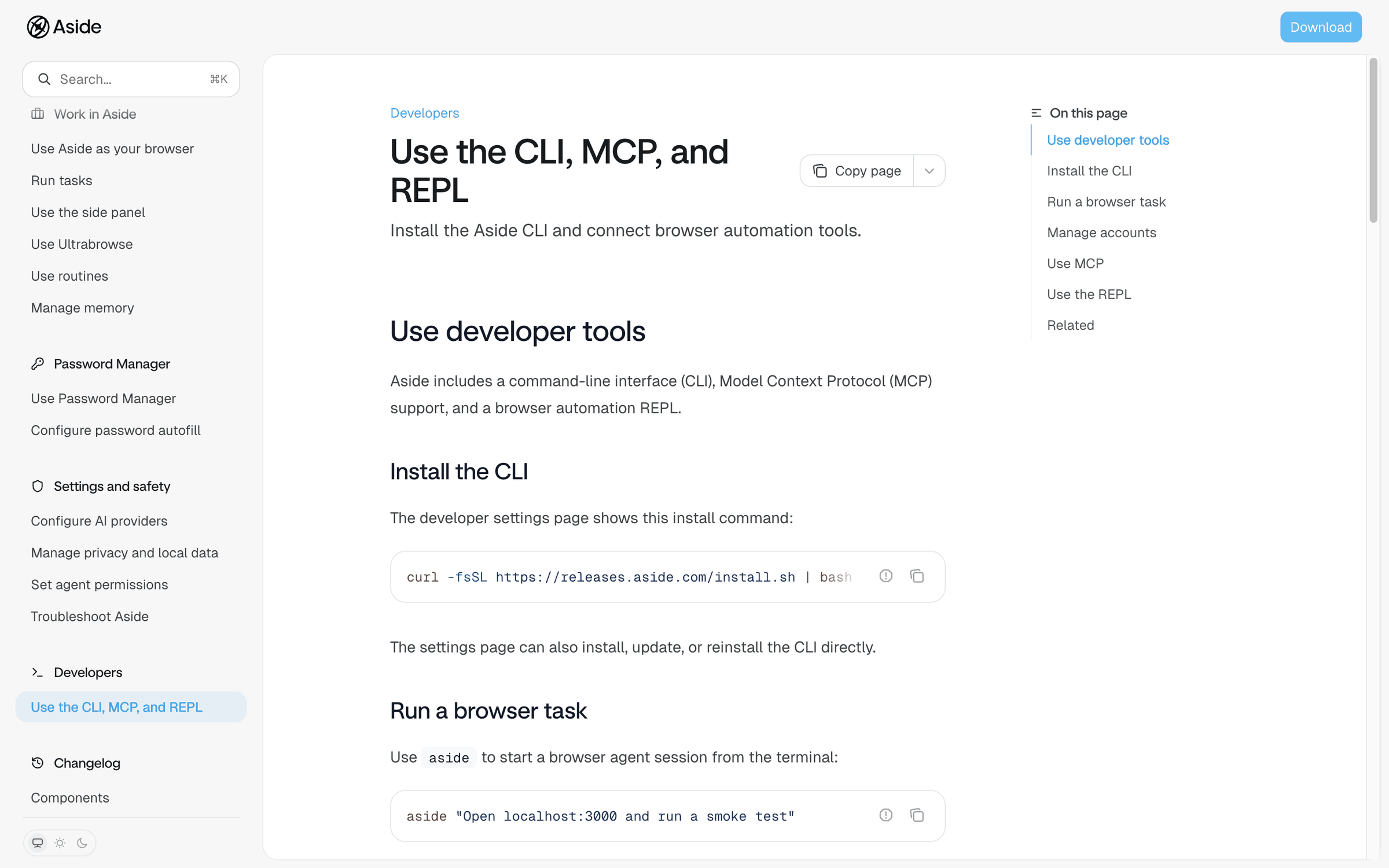
A table of the three channels shows the difference in direction.
| Channel | What it does | How it differs from Playwright |
|---|---|---|
CLI (aside "…") |
Hands a task to the agent inside the browser with one sentence from the terminal | Delegation, not control. The agent inside the browser makes the decisions |
MCP (aside mcp) |
Outside agents such as Claude Code and Codex connect to Aside as an MCP server | The browser is the server, and the coding agent is the client |
REPL (aside repl, an interactive runner where you type commands one line at a time and see results right away) |
Directly manipulates tabs, screenshots, and screen elements with code similar to Playwright’s | Same direction as the past 20 years, but inside a browser that holds your logins and memory |
Reversed direction: who calls whom
- Selenium, Playwright Outside code → inside browser The browser is an empty tool. Logins, memory, and decisions all belong to the outside
- Aside Inside browser → outside agent The browser holds the logins, the memory, and an agent, and opens itself to the outside through CLI and MCP
The company also disclosed what it costs to maintain this copy. In the July 2026 update, when it moved from Chromium 149 to 150, a cofounder said a five-person team follows new upstream Chromium versions faster than Perplexity, Dia, or Atlas (PiunikaWeb, July 7, 2026). The Chromium 152 in the measured screen above is the result of two more upgrades after that. Chromium often patches security holes, and if the copier can’t keep up, only that browser is left with the holes. Forking and modifying gains a lot, but it’s also a debt you have to pay every month.
5. Could Aside Become the Second Cursor?
The same Threads post continued:
Whether Aside can grow the way Cursor did by forking VS Code is an open question. Cursor already did browser launching and automation before, and MCP worked too; and the Atlas browser that GPT pushed earlier has been discontinued.
(Threads, anonymous user. The original post writes the name as a Korean transliteration, “Astra”; from context it refers to OpenAI’s Atlas, so I corrected it in the quote.)
Aside’s side also uses the comparison to Cursor. In the interview, Chanhee Lee says that no one thought developers would pay for an editor until Cursor changed that, and that browsers are the same. Here the two companies are side by side.
| Item | Cursor | Aside |
|---|---|---|
| What was copied and modified | VS Code (public code editor) | Chromium (public browser engine) |
| What the copy gained | Access inside the editor; features impossible with extensions | Access inside the browser; an agent with login sessions and memory |
| What already worked before | AI autocomplete via extensions | Browser control via Playwright MCP |
| Company | Anysphere, founded 2022 | Aside Computer Inc., founded 2024 |
| Scale | $29.3 billion valuation (November 2025), $3 billion annual revenue (May 2026) | Team of 5; 20,000 users two weeks after launch |
| Source | Wikipedia | YC page, eesel summary |
The structure is the same. You copy a public skeleton, gain inside access that extensions can’t provide, and make things you could already do much easier. The difference is how dense the competition is. Cursor was first to fork an editor, but by 2026 many companies had already jumped into AI browsers, and one of them had already shut down.
| AI browser | Maker | Status as of September 2026 | Source |
|---|---|---|---|
| ChatGPT Atlas | OpenAI | Launched October 2025; shutdown announced July 9, 2026; service ended August 9. Features moved to the ChatGPT desktop app and Codex | TechCrunch, 9to5Mac |
| Comet | Perplexity | Started July 2025 as a $200-a-month, subscription-only product; made free worldwide in October 2025, later expanded to mobile | CNBC |
| Aside | Aside Computer | Launched June 2026, Chromium 152 | Measured in this article |
TechCrunch’s article on the Atlas shutdown read it as OpenAI concluding that the browser is a feature, not a destination. Aside is the opposite: the browser is the product. It keeps up with Chromium updates monthly, puts the password manager and memory inside the browser, and opens that browser to outside agents. It’s a setup where a small company pushes its copy into the space a big company left.
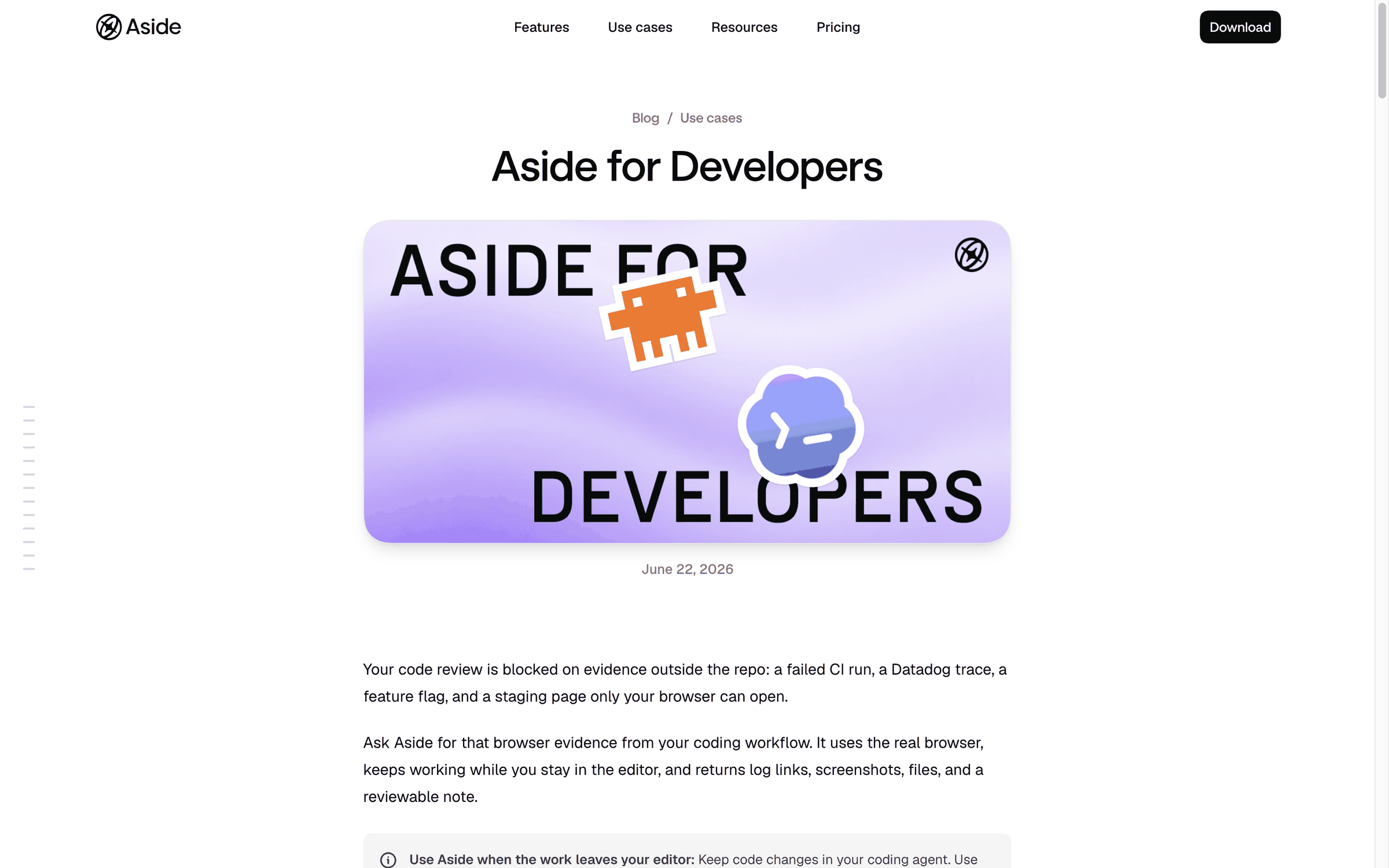
6. Summary
Sources for this article
- Y Combinator company page, Aside official help, developer page, Aside for Developers, Aside changelog
- eomag, Chanhee Lee interview, PiunikaWeb, Chromium update
- StatCounter browser market share, Wikipedia Chromium, Wikipedia Electron
- Wikipedia Selenium, InfoQ Puppeteer, Wikipedia Playwright, Wikipedia Cursor
- TechCrunch, Atlas shutdown, 9to5Mac, Atlas shutdown
The Aside-related facts in this article (company information, Chromium version, CLI and MCP setup) were checked on September 15, 2026, against the official page and inside the Aside app. The claim of first place in benchmarks is the company’s own announcement. Browser share figures and company statuses are as of that date and may change.
Frequently asked questions
- What is the Aside browser built on?
- A browser made by copying and modifying Chromium, the engine Google released publicly. Aside's version info page shows Chromium 152, and the company says it keeps tracking new Chromium releases. Founded 2024, Y Combinator Fall 2025 batch, all three founders from South Korea.
- How is Aside different from Selenium or Playwright?
- The direction is reversed. Selenium and Playwright let outside code drive the browser. In Aside, an agent lives inside the browser, and the browser exposes itself to outside agents via CLI and MCP. Because the browser already holds your login sessions and memory, the difference matters.
- Could Aside grow like Cursor?
- Too early to say. Cursor forked VS Code, gained deep editor access, and built daily-use features on it, reaching $3 billion annual revenue. Aside forked Chromium for similar access, yet OpenAI's Atlas was shut down less than a year after launch. The test is what you build from the fork.
Want the full system? The Claude Code & Codex Skills guidebook collects the skills and subagents behind this blog, from $19.
BuildnWrite helps teams build AI agents that keep running. About BuildnWrite ›