Karpathy's AI Funnel: Only 0.2% Delegate Coding to Agents Like Claude Code and Codex
Who this is forOffice workers and solo business owners who use ChatGPT now and then but don't yet feel that AI can do their work.
TL;DR: Andrej Karpathy puts the people who deeply use the latest AI for math and code, through agents, at 0.2% of the world’s population. He sees most professionals outside math and code stuck on tier 2, occasional use of free chatbots, and the office workers and business owners I meet are mostly on tier 2 too. The first step to tier 3 is handing one repetitive task you do at least twice a week to an agent like Codex or Claude Code.
Contents
- The four-tier AI funnel Karpathy drew
- Three reasons the funnel forms
- Why most office workers stay on tier 2
- What moved me from tier 2 to tier 3
- Tier 4 is hard to picture
- One thing to try tomorrow
“AI does all the work for me” and “I tried it, and it wasn’t that great” can come out of the same office on the same day. Neither one is wrong. The explanation is that the two people are looking at different AIs. Andrej Karpathy, an OpenAI co-founder who led AI and Autopilot vision at Tesla, posted this on X on October 11, 2026.
1. The four-tier AI funnel Karpathy drew
Karpathy wrote in his October 11 post that the gap in how people understand LLM (large language model) capability, such as ChatGPT and Claude, is widening. In April he had said that “two groups of people are talking past each other,” and now he describes it as a sharp funnel.
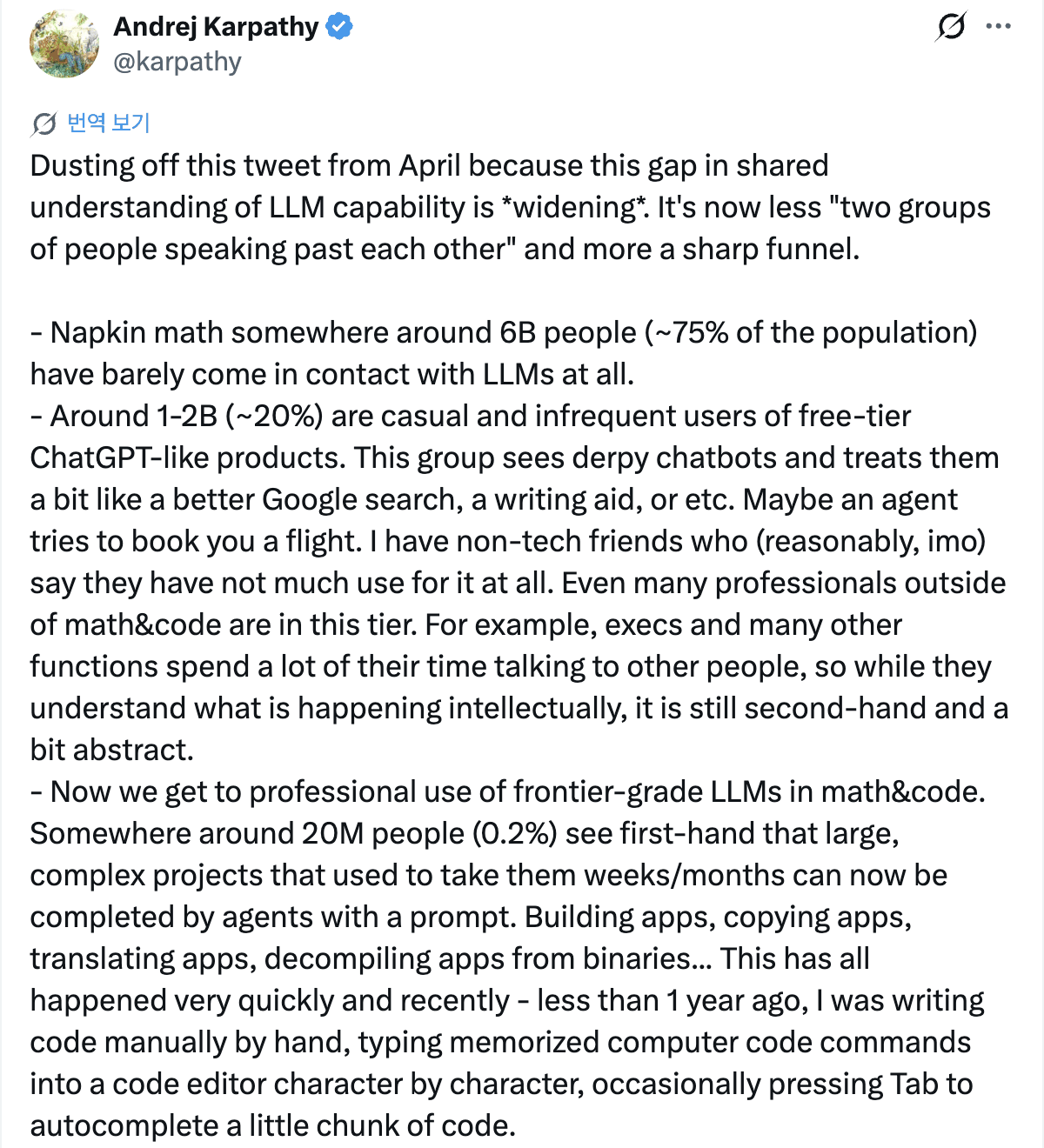
It’s now less “two groups of people speaking past each other” and more a sharp funnel.
(X post, @karpathy, October 11, 2026)
He describes the numbers as “napkin math,” rough estimates scribbled on a napkin. Read them as a sense of scale, not precise statistics.
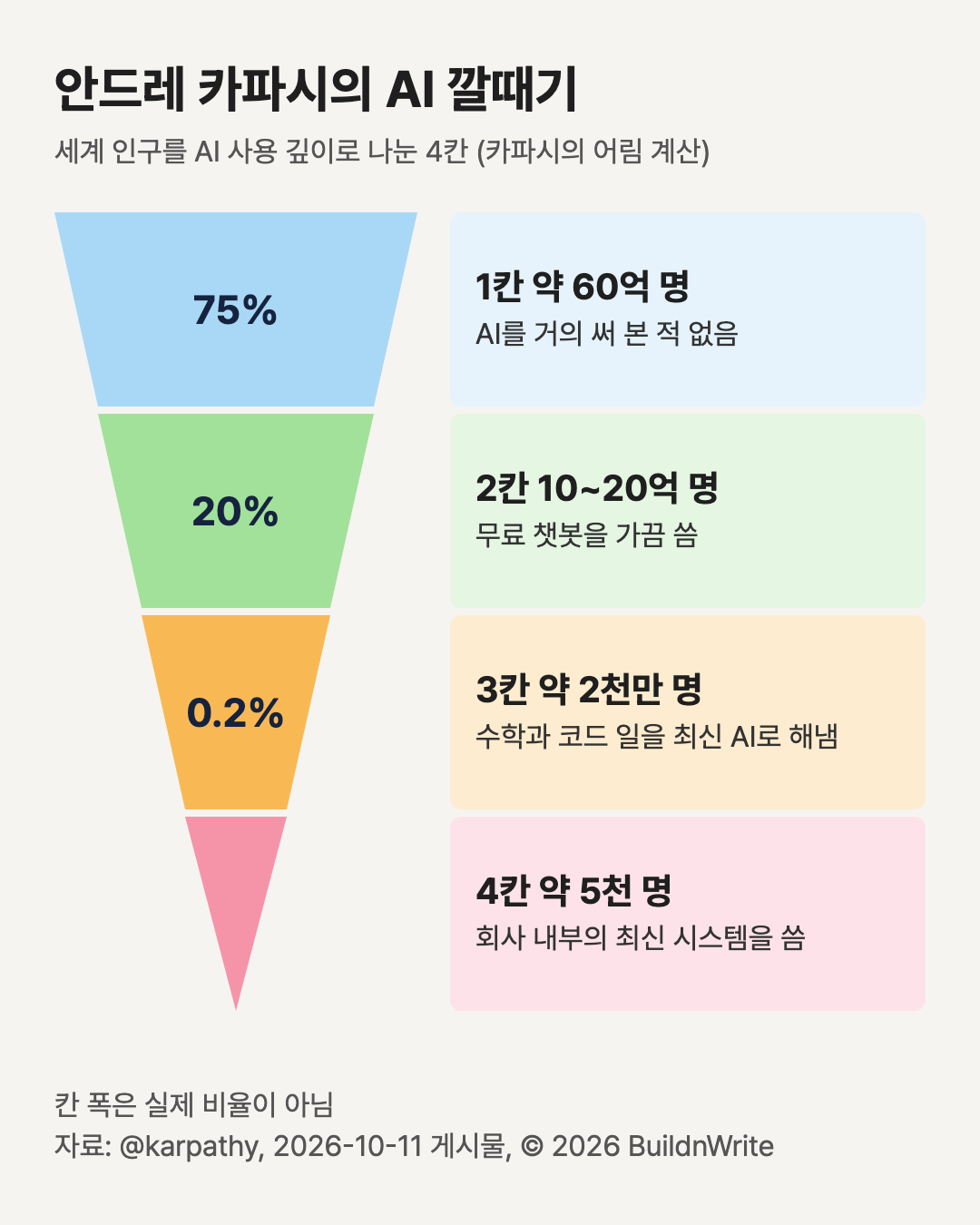
- Tier 2 sees it as a slightly better Google search or a writing helper.
- Tier 3 watches an agent finish a big project that once took weeks or months, from a single prompt.
- His examples of tier 3 work are building apps, cloning apps, porting code to another language, and reverse-engineering executables to recover the original code.
- He also noted that until less than a year ago, he typed code by hand, one character at a time.
- Tier 4 is 0.00006% of the world’s population, about 5,000 people. Section 5 covers it separately.
2. Three reasons the funnel forms
In the same post, Karpathy named three reasons people end up on different tiers.
| Factor | Details | Divides along |
|---|---|---|
| Ambition and problem size | The bigger and harder the problem you hand off over time, the more it pays off. A one-paragraph question barely strains the system | Consumers vs. professionals |
| Uneven capability | Capability spikes in digital fields where answers can be checked by machine and that pay money | Math and code vs. everything else |
| Access | Free tiers, paid tiers, and in-house company systems | Pricing plans and affiliation |
The second reason comes from how AI is trained. Training works well in fields where a machine can instantly check whether an answer is right, and AI companies focus their training effort on the areas that will pay. That is why capability in math and code jumps first.
Karpathy ended the post this way:
- Most of the public has never used it, and if they have, they see a sloppy chatbot.
- Many professionals see only a slight improvement.
- A few experience the dizziness of a curve going straight up.
- All of this is happening at the same time.
3. Why most office workers stay on tier 2
Karpathy also believed many tier 2 people are professionals outside math and code, including many executives. Since they spend most of their day talking with people, they understand what is happening in the abstract but don’t feel it from direct experience. He said it is a reasonable conclusion for non-technical friends to say there’s not much use for it.
The reason shows up first in his April post. Karpathy wrote in his April 9 post that many people had settled their judgment after trying free ChatGPT last year. Free or older models cannot show the abilities of the latest agent models released this year.
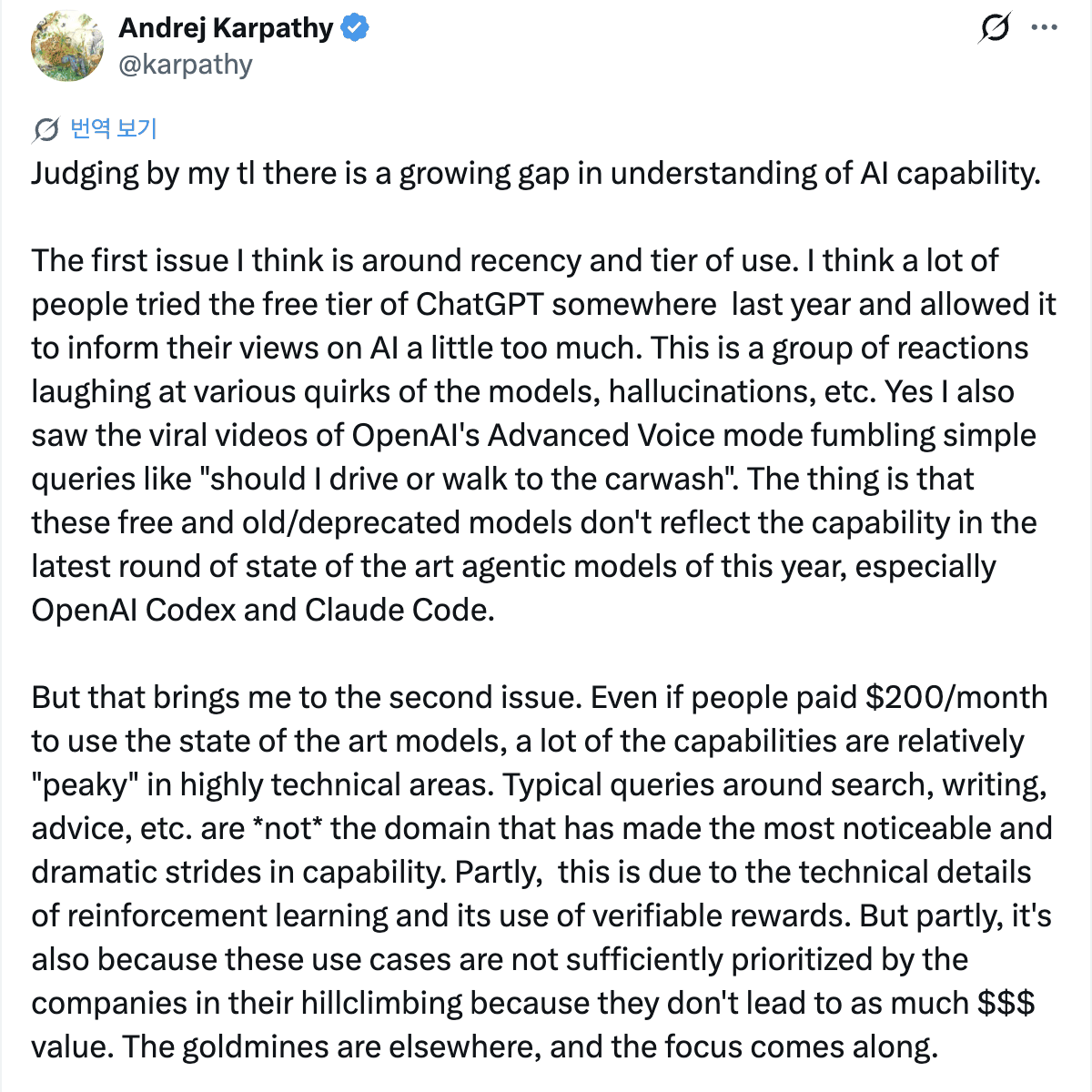
especially OpenAI Codex and Claude Code.
(X post, @karpathy, April 9, 2026)
The main point of the April post is that even at $200 a month, general questions about search, writing, and advice are not where the biggest improvements are. In a chat window, the difference is hard to feel. Karpathy said that people who pay for Codex or Claude Code and use them professionally in technical work see the model dissolve programming problems that would take days or weeks.
4. What moved me from tier 2 to tier 3
Karpathy’s tier 3 refers to people who use the latest AI professionally in math and code and personally see work that once took weeks finished with a single prompt.
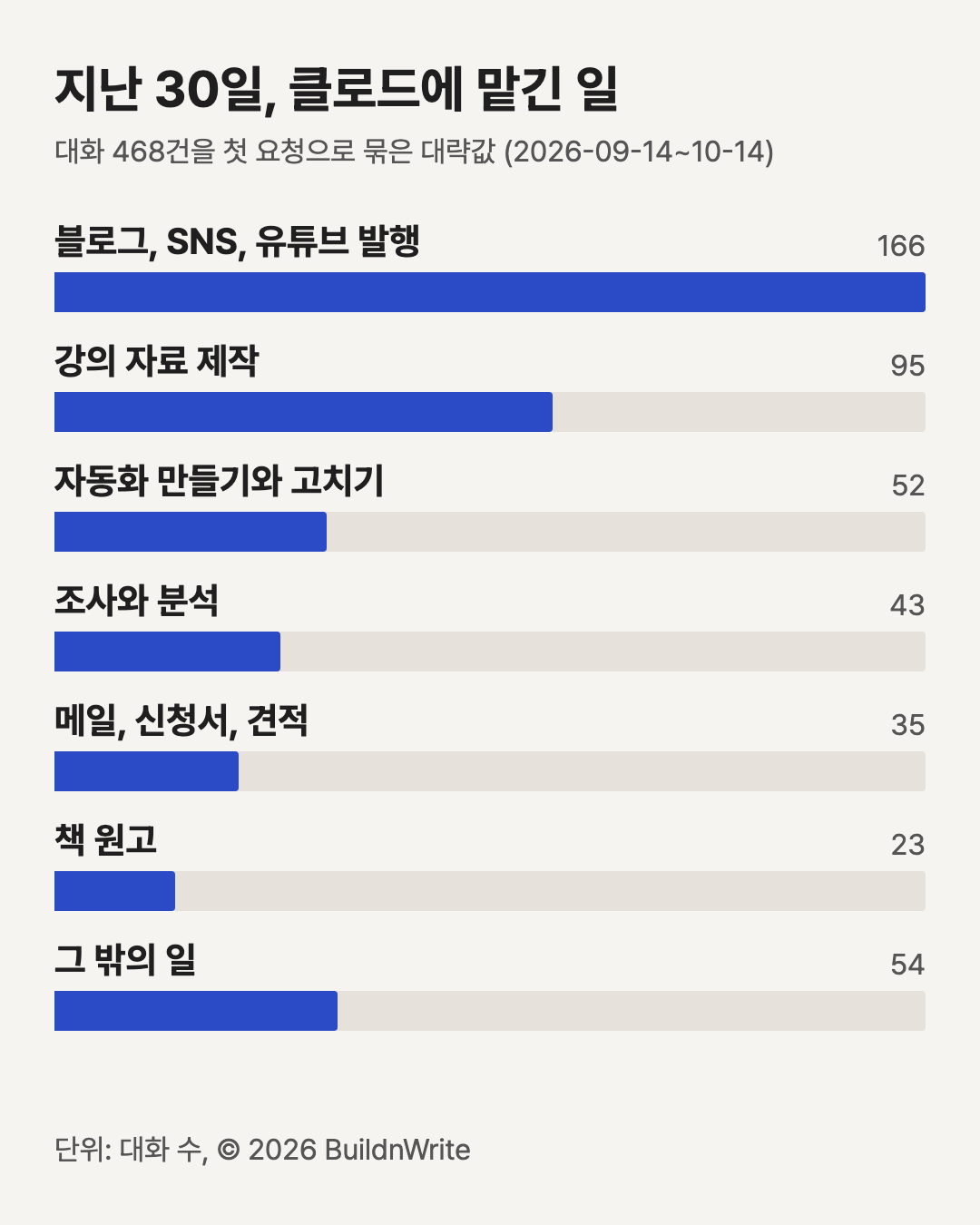
Below is how I grouped what I handed to Claude over the past 30 days, based on the first request in each conversation. I excluded scheduled jobs that run automatically on a timer and counted only the 468 conversations I started myself. Publishing, lecture materials, and email take up far more of it than development does.
5. Tier 4 is hard to picture
Karpathy’s tier 4 is about 5,000 people who use the latest systems inside companies.
- Huge software projects where thousands of agents work together for weeks
- Cyberattacks and defense that unfold at machine speed
- New scientific discoveries and the frontier of mathematics
Karpathy wrote that at this tier, human review and understanding are starting to fall behind AI. He also noted that outsiders have only seen a preview of this tier.
6. One thing to try tomorrow
The first reason for the funnel was ambition and problem size. A one-paragraph question won’t show you tier 3. You don’t have to hand over a huge project at the start, though. Begin with one repetitive task. Among the work I hand off, email, applications, and quotes come back every week, which makes them good examples. To install Claude Code, follow the guide linked below.
BuildnWrite helps teams build AI agents that keep running. About BuildnWrite ›