n8n 6-week challenge review: what participants built and what stuck
Who this is forNon-developers thinking about learning n8n, and anyone who wants to see what a cohort-style challenge actually produces.
TL;DR: 319 people signed up for the challenge to finish the book n8n Does It For You (『n8n Does It All』) and built one automation each week for six weeks. In the final week, application projects poured in, such as a Costco discount-info report, a traveler’s exchange-rate report, and a recommended annual-leave days report. The review rating is 4.9 (38 reviews). This post is the record of those six weeks.
Contents
- What the challenge was
- Weekly application projects
- Six weeks in numbers
- What participants said
- What remains after six weeks
1. What the challenge was
From May to June 2026, we ran a challenge with Hanbit Media (a Korean tech publisher) to finish the book n8n Does It For You over six weeks. It was not just a reading group. Each week, participants built one automation in step with the book’s progress and recorded it on their blogs.
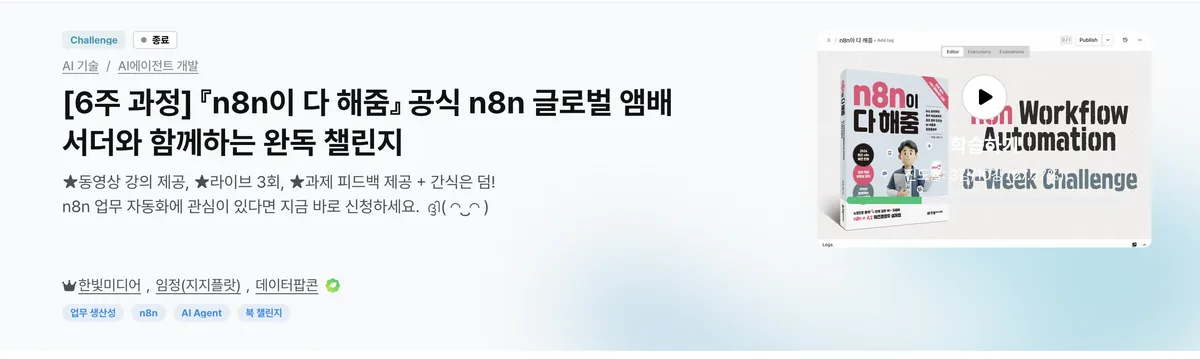
| Item | Details |
|---|---|
| Period | May 9, 2026 to June 30, 2026 (6 weeks) |
| Sign-ups | 319 people |
| Structure | 10 lessons, 7 weekly missions, 3 live sessions |
| Format | Live lectures by the authors, author feedback on every mission |
| Difficulty | Starts at beginner level (no programming experience needed) |
Each weekly mission follows a practical project from the book. Week 1 is a news-collecting bot, Week 2 is a weather alert, Week 3 is an AI agent, Week 4 is an AI meeting-notes writer, Week 5 is receipt OCR automation, and Week 6 is an investment report generator. The basic missions could be finished by following the book, but the real fun came from the advanced missions, where participants applied the same structure to their own daily lives and work.
2. Weekly application projects
Participants built things beyond the basic missions every week. Here are the application examples announced each week, grouped by week.
| Week | What you learn | Participant application projects |
|---|---|---|
| Week 1 | News-collecting bot | Company keyword newsletter, bid notice monitoring, semiconductor news alerts on Telegram |
| Week 2 | Weather alert | Travel-destination weather and exchange-rate combined report, umbrella alert only when it rains or snows, outfit recommendations by weather, coffee bean cost monitoring |
| Week 3 | AI agent | Exercise agent, stock analysis agent, trend radar agent, project planning assistant |
| Week 4 | AI meeting-notes writer | PM bot that extracts action items from meeting notes, call recording summaries, foreign-language shadowing material |
| Week 5 | Receipt OCR | Wedding gift money tracker, concert ticket archive, business card organizer, meal plan alert, automatic household ledger |
| Week 6 | Investment report | Traveler exchange-rate report, Costco discount-info report, support program notice report, recommended annual-leave days report |
My personal favorite is the Costco discount-info report from the final week. Costco does not hand out discount flyers, and participants filled that gap with automation themselves. When these examples were introduced in the final challenge announcement, one comment read, “No way, they don’t even give out flyers here!”
Here is a passage from the announcement Hanbit Media posted to wrap up the challenge.
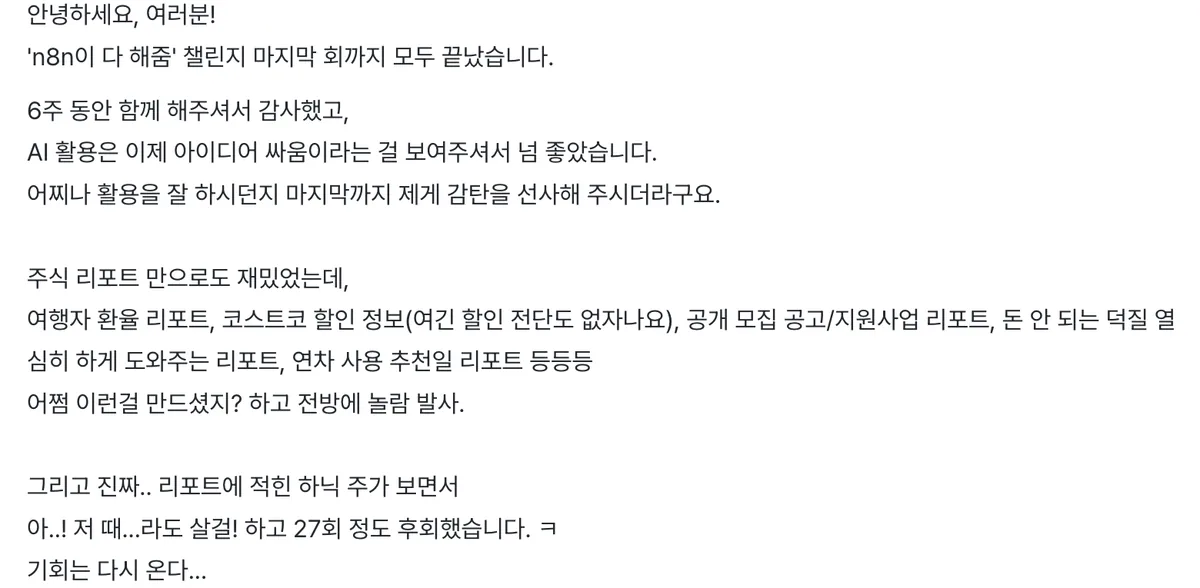
By around Week 6, participants had moved past learning the tools and into deciding what to build. One participant put it in their retrospective like this: the moment you realize that “anyone can implement something with AI, so what you build matters more.”
3. Six weeks in numbers
I’m also sharing the honest numbers. A finish-the-book challenge is naturally a format with a low completion rate. People say fewer than 10% of automation course takers make it to the end.
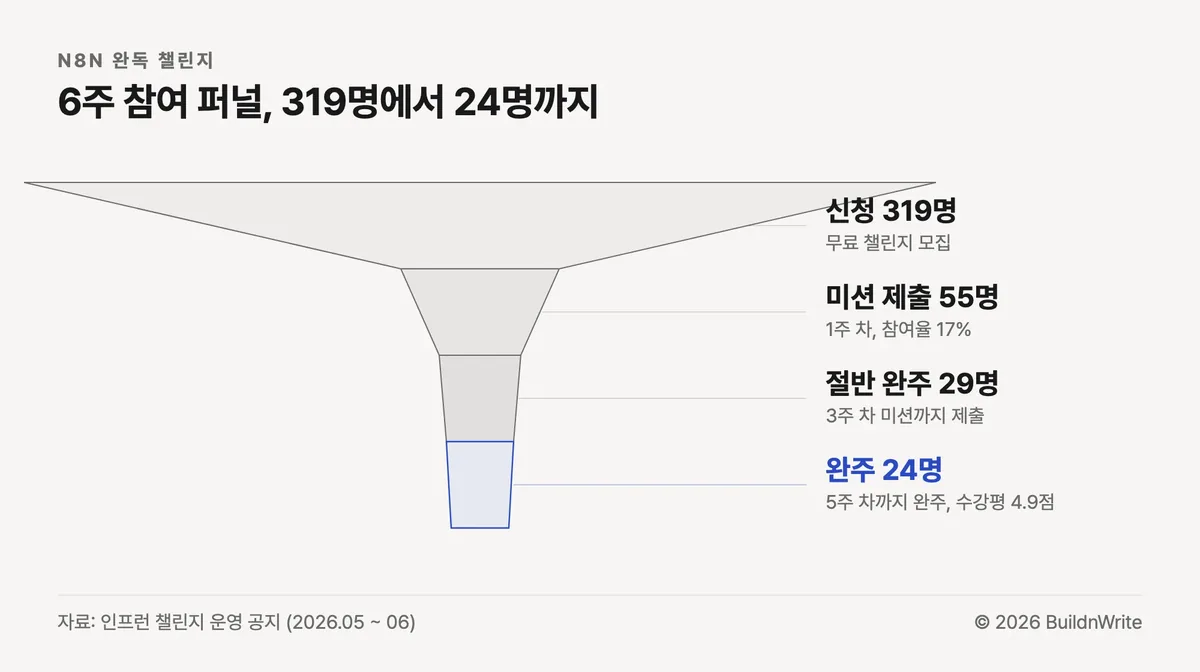
24 out of 319. The number looks small on its own, but in a free challenge where many people just sign up and leave, it also means this many people built missions every week and kept a blog record. The evaluations from the people who stayed to the end were clear.
4. What participants said
These are actual sentences from reviews and retrospectives. Nicknames are partly hidden to protect privacy.
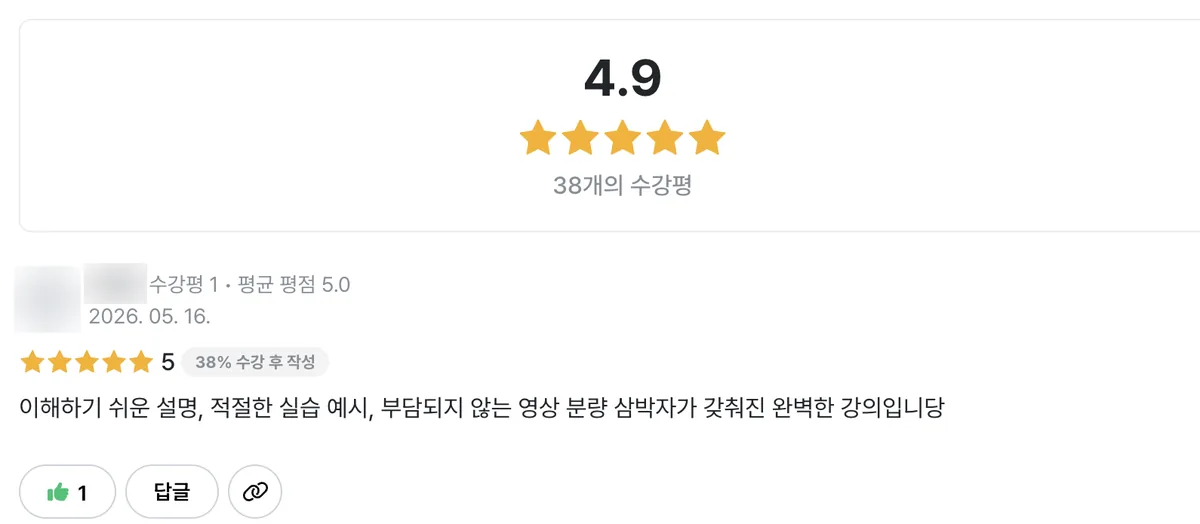
“A perfect course with easy-to-understand explanations, appropriate hands-on examples, and a comfortable video length.” (Review, Song***)
“The lectures were easy to understand, and the theme was good for connecting them with personal ideas. The lecture length was not long, so I could check the basic concepts in the lecture, follow along, and spend a lot of time thinking while implementing my own ideas during the challenge period, which made it more useful.” (Review, lu**)
“When I first signed up and first listened to the live broadcast, I felt anxious and impatient. Now, a month later, I’m somewhat used to n8n and learning a lot.” (Post-completion review, Baeungdo***)
“While watching simple repetitive tasks every day and thinking ‘can’t someone just do this for me,’ I found this book, which helps build automation systems without coding. Over six weeks, I added my own approach and was able to understand the principles of automation architecture well.” (Retrospective, Re****)
The participant who wrote the longest retrospective summarized n8n’s strengths like this:
“n8n works in a workflow-centered way, and you can directly check the input and output values of each step. Because you can visually see where data comes in, how it is processed through each stage, and how the final result is produced, it was much easier to understand and verify the process.” (Retrospective, Developer***)
Compared with vibe coding, which produces results quickly, the assessment is that n8n is a tool where every intermediate step is visible. Why this transparency matters for people learning automation for the first time becomes obvious once you build a workflow yourself.
5. What remains after six weeks
Here is what remains after the challenge, in three points.
- Six or more automations that keep running. From the news bot to the investment report, the workflows built during the challenge still run every day after it ends.
- An eye for application. The sense of fitting the same skeleton (trigger, collect, deliver) into your own daily life. The Costco report and the exchange-rate report are both just the book’s examples with the ingredients swapped.
- The experience of getting unstuck. Many retrospectives said that when the API misbehaved or the screen differed from the book, asking AI and working around the problem through trial and error became a skill in itself.
This cohort has ended, but the curriculum and mission structure are still visible on the challenge page. You can follow the same course right now with the book the challenge was built around and the introductory course. Building something like the Costco report six weeks later is not as far away as it might seem.
Frequently asked questions
- How many people finished the n8n Does It For You challenge in 2026?
- 24 of the 319 people who signed up built missions every week and kept a blog record. The funnel shows 24 completed through Week 5.
- What is the review rating of the n8n finish-the-book challenge on Inflearn?
- The challenge page on Inflearn has a review rating of 4.9 from 38 reviews.
Want the full system? The Claude Code & Codex Skills guidebook collects the skills and subagents behind this blog, from $19.
BuildnWrite helps teams build AI agents that keep running. About BuildnWrite ›