GEO Is About Citation Probability, Not Answer Control: A B2B Organic Content Playbook
Who this is forMarketing leads and content strategists at B2B companies and content businesses who want to understand GEO without buying promises of guaranteed placement in AI answers.
Most B2B marketers who hear about generative engine optimization (GEO) assume the goal is to get their brand named inside AI answers. In a 49-minute interview, Kim Ye-ji, CEO of Elephant Company, a content and GEO agency, argues that this framing is wrong. She says her company grew its share of large corporate clients to about half of its business over six years without running paid ads. For her, GEO means making AI systems see a brand as a trustworthy source, which raises the probability of being cited. It does not mean controlling what an answer says. This article reconstructs her framework: where a brand can act in the AI answer pipeline, how to build content around customer questions, which content types AI can draft, and how to structure a B2B website. It also marks which claims are unverified.
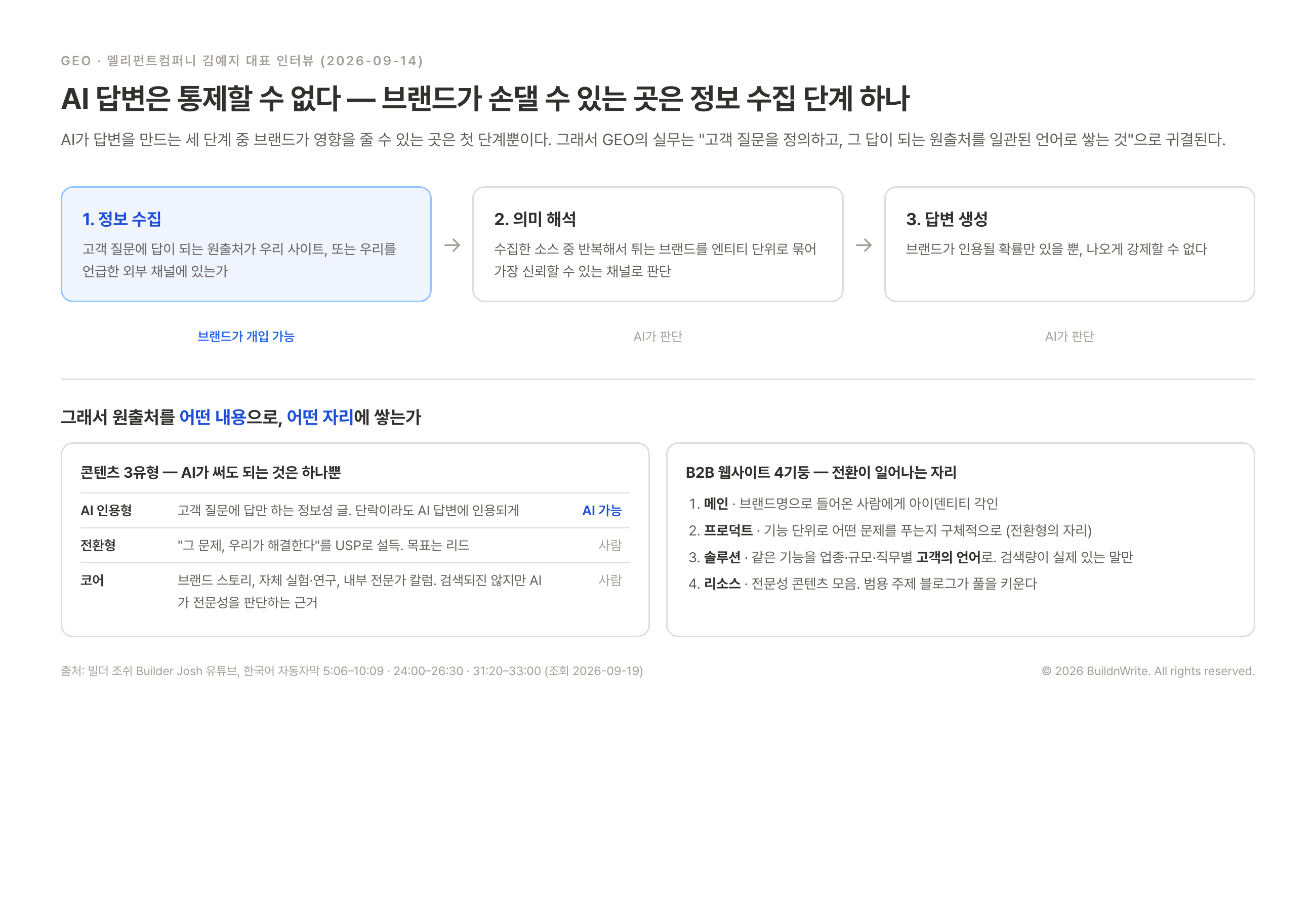
The core idea in one diagram
Overview of the source video
| Item | Value |
|---|---|
| Title | How to grow large corporate clients to half of the business without running ads for six years (Elephant Company CEO Kim Ye-ji) |
| Channel | Builder Josh (run by Joshua & Company) |
| Upload | September 14, 2026; 49:34; 9,877 views as of September 19, 2026 |
| Guest | Kim Ye-ji, CEO of Elephant Company, six years into the business; began her career as a “writing marketer” |
| Captions | Korean auto-generated by YouTube; no manual captions; some proper nouns misrecognized |
| Flagged segment | t=1640s (27:20), just before the chapter “AI content workflow and human fact-checking” (27:32) |
The captions are automatic, so several terms were misrecognized. For example, “USP” was transcribed as “USB,” and the name of the Sage case study appeared with a spelling error. The note corrects these from context. The flagged segment at t=1640s is a demonstration of the company’s in-house AI writing engine.
What GEO means and where brands can act (5:06–10:09)
Kim defines GEO as all activities that make a brand consumable and trustworthy from the perspective of AI (5:06). In the SEO era, customers read search results themselves. Now they ask questions, and AI makes the judgment. GEO is the overall approach to make a brand look like a credible source to that AI.
She uses a brand-recall analogy (6:20). In the 1980s and 1990s, when TV and radio were the main media, Gebolin, a Korean painkiller brand, tied its name to “headache, toothache, and menstrual pain” through repeated exposure. Today the judgment is made by AI as well as by customers, so the connection has to exist in the media AI consults: the brand’s website, reviews, and press coverage. This is why integrated marketing communications (IMC) matters again (7:30).
Kim says that any agency promising your brand will always appear in AI answers is running a scam (8:05). What a brand can do is raise the probability of being cited. Trying to control or manipulate answers does not match how these systems work.
AI builds answers in three stages: information gathering, semantic interpretation, and answer generation. A brand can influence only the information-gathering stage (9:00). Its job is to make sure the original source for a specific customer question sits on its own site or on external channels that mention it. In the interpretation stage, AI groups brands that repeatedly appear across sources into entities and judges which are most trustworthy (9:30). So the priority is to understand the customer’s question and keep building content that answers it with real depth in the topic, rather than trying to appear in answers directly (10:00).
Entities: brand identity as AI sees it (10:09–13:02)
Kim uses a demo of the Google Natural Language API as an example (10:20). The AI splits text into meaningful units, tags each unit with a label such as price, number, address, or organization, and infers meaning from the relationships among entities.
For a brand to come up as the answer to a topic, its name has to keep appearing next to the explanation of that topic (11:20). Kim describes this as expressing brand identity in consistent language that AI can read (11:40).
Three starting questions and why B2B favors written content (13:02–19:03)
When a new client engagement starts, the first step is a diagnosis built on three questions (13:00):
- What is the business and marketing goal? Is it lead generation or awareness?
- Who is the target customer in the problem situation the product solves, and what exactly is that problem?
- What is the USP, the unique selling point that solves that problem?
In her view, matching the customer problem to the USP is what makes both citation and customer attention follow.
In a free 30-minute marketing consultation, she checks only two things (15:00). The first is form: can AI and search engines read the site? The second is content: does the company have brand assets that tell the story of solving the customer’s problem?
She argues that B2B purchases are hard to persuade with performance ads (15:30). If a company must run ads, a single refined article works better than a landing page (16:00).
The reason lies in how high-involvement purchases work (16:30). Nobody buys a KRW 2,000,000 bicycle after seeing only an ad. Buyers search repeatedly, read reviews, and ask whether the seller can be trusted. The format that persuades at this stage is structured text with an argument and evidence, which is to say, a story.
Elephant Company’s own inflow works the same way. About 70% of its leads come from organic search and 30% from referrals by existing clients (17:50). If it runs ads, it promotes its own content, such as a report on GEO readiness for Korean companies. The key is to follow the whole customer journey, from awareness through search rediscovery and inquiry to a diagnostic consultation, rather than looking at fragments of it (18:30).
Project steps and customer language research (19:03–25:34)
Kim describes the GEO project sequence as follows:
- Diagnose the current state using the three questions: goal, customer, and USP.
- Explore the customer’s actual language through keyword search. The team uses ListeningMind from Ascent Korea, a Korean keyword tool that adds up Google and Naver search volumes and groups related searches into clusters (19:30). Naver is South Korea’s largest search portal. Kim says the tool “opens up the customer’s brain.”
- Infer the customer’s state from search volume and the specificity of the query. For example, “manufacturing automation” gets about 7,000 searches per month. The surrounding related terms show whether the searcher wants a meaning, a method, vendors, or case studies (20:30).
- AI could do this inference, but it cannot yet express the team’s experiential judgment. So the work loops: AI runs quickly, and a person adjusts each intermediate output for the client (21:00).
- Define the customer journey in three to five stages. For each stage, record the customer’s characteristics, intent, and questions, then build a list of answers (22:30). One example is manufacturing AX (AI transformation): initial exploration, then success cases, then adoption review, where security and integration concerns come up.
- “Content” here means every page on the site, including service, feature, solution, and resource pages, not only blog posts (23:20).
Three content types: what AI can and cannot write (24:00–26:30)
Kim sorts content into three types, and only one is suitable for AI drafting.
| Type | Purpose | AI-written? |
|---|---|---|
| AI citation type (formerly the traffic type) | Informational posts that answer a customer question directly. People rarely click through to results, so the goal is for a passage to be cited in an AI answer | Yes |
| Conversion type | Persuade readers in the customer’s problem situation that “we can solve this,” using the USP. The goal is lead conversion | No |
| Core type | Thought leadership: brand stories, original experiments and research, and columns, interviews, or papers by in-house researchers. These show expertise outsiders cannot copy. Few people search for them, but AI uses them to judge whether the brand has expertise | No |
Her reasoning (26:00) is that brand trust comes from conversion and core content rather than from traffic content. Those types require a point of view and a consistent tone, so attempting to produce them with AI may not be appropriate.
AI writing engine and human review (26:30–30:15)
Before AI tools, the team wrote about 1,500 pieces of content per year by hand. In the second half of last year, it turned that know-how into an in-house engine (26:40). The engine learns from articles the team judged well written and from early drafts it found lacking. The goal is to keep outputs at 80 or higher on a 100-point scale defined by the team’s own standards (27:10).
The workflow runs in this order (27:20–28:30):
- A person writes the title and outline first.
- Sources are attached.
- The operator sets the content type, client, author, and tone.
- The operator chooses whether the engine uses only the RAG folder of core client information or adds external research.
- The engine generates the draft. Results go to a Notion database.
The model setup works as follows (28:10). On Vertex AI, Perplexity handles web research. GPT and Claude each write a draft, and the higher-scoring draft is then rewritten. A scoring rubric turns qualitative judgments into numbers. Anything below 80 is rewritten, and the strongest passages from high-scoring drafts are combined to produce an 80-plus version (28:40). The engine also generates image prompts.
Kim says the format is fixed, so the engine can produce it repeatedly, while the content is controlled by people (29:00). She is blunt about the limits: “This must not end here” (29:40). A person has to fact-check the draft and confirm that the perspective comes through. Rereading often reveals logical leaps or phrasing that weakens trust, and those must be filtered out (29:50).
Four website pillars and two case studies (30:15–41:04)
For B2B and high-involvement products, the website matters most, because final conversion happens there (31:20). Kim’s framework has four pillars (31:40–33:00):
- Main page: Imprint the brand’s identity on people who arrive by searching the brand name. Use impact, not lengthy text.
- Product pages: Explain concretely which problem each feature solves. This is where conversion content belongs.
- Solution pages: Express the features in the customer’s language, organized by industry, company size, or job role.
- Resource pages: A collection of expertise content.
She says the framework comes from analyzing more than a dozen globally listed startups and extracting their common features. She estimates that six of every ten Korean companies still do not have a working website (33:00).
Case 1: Sage, a machine-vision AI company selling to businesses (30:20–37:00). Its site had three pages and a few blog posts. The team rebuilt it into three product-level pages, six pages of use cases from the customer’s point of view, an expertise blog, and a company introduction. For secondary-battery customers, the solution pages used process language: secondary-battery quality inspection, battery stability, and electrode, stack, and assembly processes. For food packaging plants, the language was food foreign matter and packaging defect rate. Kim’s rule is to use only language that has real search volume (36:00). Solution pages with low search volume need broad-topic blog posts, such as “manufacturing AX,” to bring in visitors (36:40).
Case 2: Brew, a video subtitle automation tool selling to consumers (37:20–38:10). The original site was a single page. It was split into more than 20 pages, one for each feature. “Auto subtitles” and “automatic silence removal” each get about 40,000 to 50,000 searches per month, so each feature got its own page, with a direct path to download or conversion.
The host of the video admitted that he had only been doing blog posts and had not considered building several landing pages inside the website (38:30). Kim’s response: blogs bring in traffic, but they do not connect directly to conversion.
Onsite, offsite, and the market outlook (39:30–48:00)
AI does not look only at a company’s own channels (39:30). Kim’s approach is to set up the onsite version, meaning the site the company controls, as the original source first. Then offsite channels, such as press, reviews, social media, communities, and influencer guide documents, spread the same language (40:30–41:10). For B2B, which is a specialized industry, owned channels are cited at a higher rate. She also observes that since a ChatGPT update in May 2026, research tends to surface brands more often (41:40). This is her observation, and it is not verified.
The easiest offsite steps for a startup are a Google Business Profile, a Bing profile, and a page on Namu Wiki, the Korean wiki. Her advice: “Nobody is doing this, so start here” (42:20). These are not for customers. They are a way to make AI see the company in relevant topics.
To the objection that results take too long, she answers with a case (43:30). Ads stop working when the spending stops. Content is an infrastructure investment that builds brand knowledge on the web. A client from three years ago still sees traffic and AI-driven results rising (44:20).
On the market, she says GEO emerged less than two years ago and is now overheated and chaotic (44:40). Domestic SEO trails the global market by seven to eight years, so the claim “SEO is unnecessary, do GEO” fits overseas markets but not Korea. In Korea, she argues, companies should finish the neglected SEO work first, establish their own site, and then move to GEO (45:20). She expects short-term tactics to be judged as abuse and to decline.
On the future of marketers (46:30), she says the ability to think from the customer’s point of view and define the customer remains essential. Engineering skills are being added on top of that. Marketers who are good only at producing content will fall behind, and the market needs people who build systems and tune results. She cites the overseas GEO firm Profound, which promotes a “marketing engineering” role (47:20). She expects demand to grow for marketers who use tools such as Codex and Claude Code well.
Applying the framework to BuildnWrite
The framework maps onto a content business such as BuildnWrite in several ways.
-
The three content types fit the existing channels. Blog posts that target search queries are citation-type content. Course and workshop pages are conversion content. Experiment results, books, and frameworks are core content. By Kim’s standard, only the first type should be drafted with AI. Core content depends on the author’s perspective and tone, so people should write it. Comparison experiments built with the
run-experimentskill match her definition of core content: original experiments and research. -
The one-line frame can anchor a GEO course. The idea that a brand can act only on information gathering separates two approaches: tactics aimed at controlling answers, which fail, and building original sources, which raise citation probability. The
geo-site-auditskill checks whether AI crawlers can read pages, which corresponds to Kim’s “form” check. The three content types and four pillars correspond to her “content” check. -
The four pillars can guide a home page redesign. The current site relies mainly on blog posts and a link tree. It is worth checking whether product pages that break course features into individual functions are missing, and whether solution pages for each audience exist, such as corporate training managers, individual learners, and publishers. Each page should target only language with real search volume.
-
The AI writing workflow matches the existing principles. A person sets the title and outline, AI fills in the format, and a person fact-checks and reviews the perspective. Running two models and choosing between them with a scoring rubric could inform the light versus deep tier decision in the
researchskill. The video does not disclose the rubric itself, so it cannot be reused as is. -
The claim needs a counterweight. Kim’s argument that “SEO is over, do GEO” is backwards in Korea is worth citing as a counterpoint to the local GEO discussion. However, her figures, the seven to eight year gap and the six of ten companies without a working website, are her own estimates rather than measured data.
Points worth quoting, all paraphrased from the video:
- Raising the probability of being cited in AI answers is the goal, not guaranteed placement (8:15).
- AI-generated drafts must not be published without human fact-checking and review (29:40).
- If a B2B company must run ads, promoting one carefully written article works better than a persuasive landing page (15:50–16:10).
- Content marketing is an infrastructure investment that builds brand knowledge on the web, not a form of ad spend (43:40–44:00).
Bottom line
The evidence in this video supports a narrower claim than the GEO hype suggests. A brand can influence only the information-gathering stage of AI answers, so the practical work is to build original sources around specific customer questions and keep the language consistent across the company’s site and external channels. Citation-type posts can be drafted with AI and then fact-checked, while conversion and core content need human perspective. B2B sites should cover product, solution, and resource pages, and results take time to appear. The growth figures, the market timeline, the May 2026 ChatGPT observation, and the claims about Profound’s hiring are the speaker’s own account and remain unverified.
Sources
- Builder Josh, “How to grow large corporate clients to half without running ads for six years” (Elephant Company CEO Kim Ye-ji). Published September 14, 2026; 49:34 long. The captions are YouTube’s automatic Korean captions, with proper nouns corrected from context. The guest runs a GEO agency, so her method naturally favors her own approach. Reliability: medium.
- Video description timestamps and seven key points, written by the channel and checked against the captions. Reliability: high for what the channel wrote.
- Local transcript files: transcript-full.txt and transcript-full.ko.vtt.
- Accessed September 19, 2026. Every factual claim in this article comes from the captions. Company revenue, client results, and Profound’s hiring policy were not verified.
Frequently asked questions
- Can AI write every type of B2B content?
- No. The framework allows AI drafting only for citation-type informational posts. Conversion pages and core thought-leadership content depend on a company's own perspective and tone, so people should write them.
- What can a brand actually control in AI answers?
- Only the information-gathering stage. A brand can make its own pages and external mentions the source AI finds for specific customer questions, which raises citation probability. Guaranteed placement in answers is not realistic.
Want the full system? The Claude Code & Codex Skills guidebook collects the skills and subagents behind this blog, from $19.
BuildnWrite helps teams build AI agents that keep running. About BuildnWrite ›