Google's Generative AI Search Optimization Guide: AEO and GEO Are Still SEO
Who this is forSEO practitioners, content creators, and marketers deciding whether to change their strategy for AI Overviews and AI Mode.
Over the past two years, marketing circles have sold “AEO” (Answer Engine Optimization) and “GEO” (Generative Engine Optimization) as new disciplines, complete with certifications, consulting packages, and software tools. On May 15, 2026, Google published its first consolidated guide to optimizing websites for generative AI features in Google Search, and its central message is short: AEO and GEO are the same as SEO. This article walks through what the guide recommends, what it explicitly calls unnecessary, and how the mechanisms it describes should change your priorities. You will get the key data in tables, the exact wording of the lines that matter, and a clear picture of what to do next.
One-Line Summary
The conclusion of Google’s guide, published on May 15, 2026, fits in one sentence: “AEO and GEO are the same as SEO. There is nothing new to do; just do SEO better.” AI Overviews and AI Mode are not separate systems. They sit on top of the core Search ranking and quality systems, adding retrieval-augmented generation (grounding) and query fan-out. Because of that architecture, Google explicitly says that llms.txt files, content chunking, AI-specific markup, and the special writing techniques promoted by “GEO consulting” are unnecessary. What has changed is the quality bar. First-hand experience, a distinct point of view, and clear structure matter more than they did before.
Core Diagram
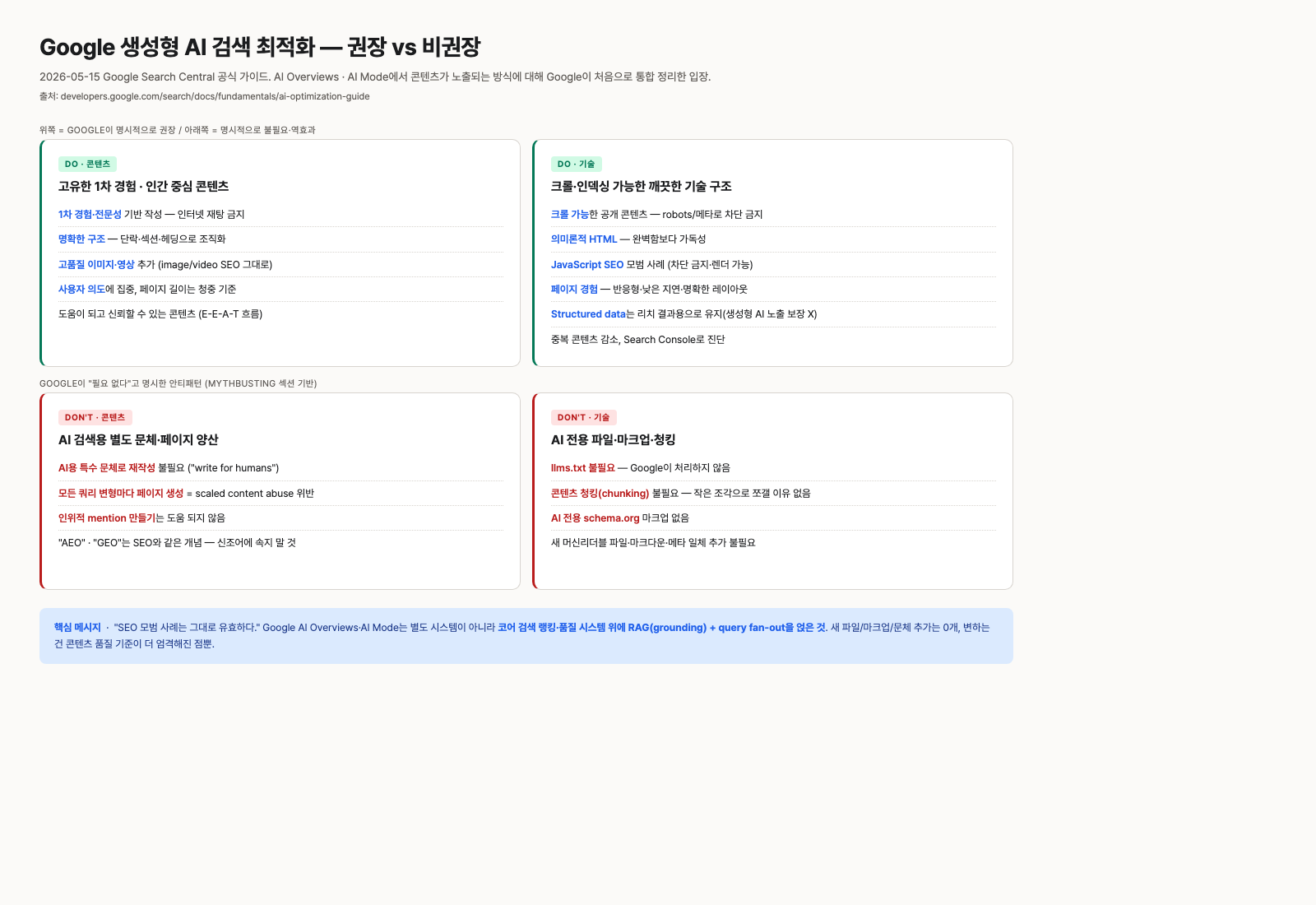
The diagram separates the practices Google recommends from the ones it discourages. The tables below give the details behind each category.
Key Data
1. Announcement Metadata
| Item | Value |
|---|---|
| Published | May 15, 2026 |
| Title | “Optimizing your website for generative AI features on Google Search” |
| Channel | Google Search Central Blog (John Mueller) |
| URL | https://developers.google.com/search/docs/fundamentals/ai-optimization-guide |
| Significance | Google’s first official consolidated document on optimizing for generative AI search |
| Direct quote | “The best practices for SEO continue to be relevant because our generative AI features on Google Search are rooted in our core Search ranking and quality systems.” |
2. AI Surfaces Mentioned in the Guide
| Surface | Description |
|---|---|
| AI Overviews | An AI summary box generated at the top of search results |
| AI Mode | A conversational search mode (question → answer-style response) |
| Regular search results | Traditional 10 blue links, sharing the same core ranking system |
→ All three surfaces produce output in different forms on top of the same core system. There is no separate index and no separate crawler.
3. Recommended: Content (Create valuable, non-commodity content)
| # | Recommendation | Quote / basis |
|---|---|---|
| 1 | First-hand and expertise-based content | “Don’t just recycle what others on the internet have already said” |
| 2 | Clear structure with paragraphs, sections, and headings | “People generally appreciate it when web pages are organized by paragraphs and sections, along with headings that provide a clear structure” |
| 3 | High-quality images and video | The same image and video SEO best practices apply |
| 4 | Focus on user intent | Page length should be based on the audience; there is no ideal length |
| 5 | Helpful, trustworthy, people-centered content | “helpful, reliable, people-first content” (follows the E-E-A-T approach) |
| 6 | Follow Search Essentials and spam policies when using generative AI tools | Using AI is allowed; abusing it is not |
4. Recommended: Technical Structure (Build and maintain clear technical structure)
| # | Recommendation | Note |
|---|---|---|
| 1 | Meet Search technical requirements | Keep pages indexable and eligible to show snippets |
| 2 | Crawlable public content | Blocking pages with robots.txt or meta tags prevents them from appearing |
| 3 | Use semantic HTML | “Readability over perfection,” with screen reader accessibility in mind |
| 4 | JavaScript SEO best practices | Google can process content rendered by JavaScript, but you should not block it |
| 5 | Page experience | Responsive design, low latency, and a clear layout |
| 6 | Reduce duplicate content | Canonicalization, as before |
| 7 | Keep structured data for rich results | No guarantee of appearing in generative AI results. This is an explicit statement. |
5. Anti-Patterns Google Calls Unnecessary (Mythbusting Section)
| Item | Google’s position | Direct quote |
|---|---|---|
| llms.txt file | Unnecessary | “You don’t need to create new machine readable files, AI text files, markup, or Markdown to appear in generative AI search” |
| Content chunking | Unnecessary | “There’s no requirement to break your content into tiny pieces for AI to better understand it” |
| Rewriting in an AI-specific style | Unnecessary | “You don’t need to write in a specific way just for generative AI search” |
| Pursuing artificial mentions | Not helpful | “Seeking inauthentic ‘mentions’ across the web isn’t as helpful as it might seem” |
| AI-specific schema.org markup | None | “There’s no special schema.org markup you need to add” |
| Creating pages for every query variation | Violation | “doing so primarily to manipulate rankings or generative AI responses in Google Search violates Google’s scaled content abuse spam policy” |
6. Two AI Search Mechanisms the Guide Defines
| Term | Google’s definition | Meaning |
|---|---|---|
| RAG (Retrieval-Augmented Generation, = grounding) | “A technique used to improve the quality, accuracy, and freshness of AI responses by relying on our core Search ranking systems” | AI answers are generated from core search results, so SEO ranking carries over directly |
| Query fan-out | “A set of concurrent, related queries generated by the model to request more information” | One user question expands internally into several search queries, which is why creating variant pages has no value |
7. Google’s Official Position on the “AEO” and “GEO” Terms
| Term | Industry marketing meaning | Google’s official position |
|---|---|---|
| AEO (Answer Engine Optimization) | “The new SEO for the answer engine era” | “Same as SEO”: not a new category |
| GEO (Generative Engine Optimization) | “New optimization for generative search” | “Same as SEO”: not a new category |
→ Search Engine Journal headline: “Google’s New AI Search Guide Calls AEO And GEO ‘Still SEO’”
8. Overall Section Structure of the Guide
- Is SEO still relevant for generative AI search?
- Apply foundational SEO best practices to generative AI search
- Create valuable, non-commodity content for your audience
- Build and maintain a clear technical structure
- Optimize your local business and ecommerce details
- Mythbusting generative AI search: what you don’t need to do
- Explore agentic experiences (mentions UCP and browser agents)
- Next steps: what to focus on
- Stay informed and ask questions
Insights
1. Google Directly Rejected the Market Selling Consulting Around “AEO” and “GEO”
In 2024 and 2025, “AEO” and “GEO” circulated in the marketing industry as if they were new categories. New certifications, new consulting packages, and new software tools appeared one after another, and headlines declaring that SEO was over were everywhere. This guide officially contradicts that narrative. It includes a dedicated “What about ‘AEO’ and ‘GEO’?” box, and the answer is “same as SEO.” Google has put it on the record that these terms are marketing vocabulary, not categories Google recognizes.
→ Positioning such as “AEO expert” or “GEO consulting” in the consulting, course, and tools market is likely to lose credibility sharply after May 15, 2026. Once clients read the guide itself, they are more likely to conclude that someone who does SEO well is enough.
2. A Decisive Defeat for the llms.txt Camp
Since 2024, Anthropic, Mintlify, and others have promoted the llms.txt proposal, which suggests placing an llms.txt file at a site’s root so that AI systems can better read its content. Over the past year, some sites (parts of Anthropic Docs, Stripe, and HuggingFace) adopted it, and the idea was even compared to a “next-generation robots.txt.”
The guide’s sentence “You don’t need to create new machine readable files, AI text files, markup, or Markdown” is the first official position that directly rejects llms.txt. The key point is that Google does not process these files. Whether other AI companies process them is a separate question, since their crawlers may follow different policies. Still, in an environment where Google handles about 90% of search traffic, as the source note puts it, this effectively ends the attempt to standardize llms.txt for search.
→ Anyone who has turned “llms.txt generation” workflows or tools into a content asset should reconsider their positioning. The format is not completely dead, though, because OpenAI’s and Anthropic’s other crawlers may follow different policies.
3. The End of the “Content Chunking” Myth
As RAG spread between 2023 and 2025, advice such as “long articles are unreadable for AI, so split them into short pieces” and “write each heading to stand on its own” circulated across SEO blogs and video channels. This was a case of applying the embedding chunk size limits of RAG systems (512 to 8192 tokens) to content writing.
The guide’s statement “There’s no requirement to break your content into tiny pieces for AI to better understand it” reaches the opposite conclusion. Google handles retrieval on its side, and content creators should maintain a length and structure that people find easy to read. The guide’s remark that there is no ideal page length reinforces the point.
→ The real shift in SEO is that writers can stop obsessing over chunk size. Short paragraphs and excessive H3 splitting, a trap that bloggers and newsletter writers often fall into, reduced content depth and therefore hurt results.
4. Disclosing the RAG and Query Fan-Out Mechanisms Clarifies SEO Strategy
For the first time, the guide explicitly describes two mechanisms:
- RAG (grounding): AI answers are generated from core search results. In other words, search ranking is effectively the probability of being cited in AI Overviews.
- Query fan-out: One user question is expanded by the model into several related queries internally, and the results for each are synthesized.
The strategic conclusions that follow are:
- You do not need to create a page for each query variation. The model fans out the query on its own, so one deep page can match several variant queries at once.
- Being cited in AI Overviews equals ranking high in core results plus having clear, citable sentences. Pages that already perform well in SEO are cited in AI Overviews as they are.
- Artificial mentions, the SEO trick of putting your name on external sites, do not work. The core ranking system already weights natural links more heavily.
→ Getting cited in AI Overviews is not a separate skill set. It is an extension of the E-E-A-T approach and clearly citable writing that have worked since the 2010s.
5. Implications for Solo Creators and the Course Content Market
- Repositioning “AI-era SEO” courses: Materials packaged as “AEO and GEO courses” are likely to lose client trust after May 15, 2026. It is worth realigning titles and introductions around “AI search optimization based on Google’s official guide.”
- First-hand experience content matters more now: Information recycled from across the internet is harder to get cited by AI Overviews. Personal experience, measured data, and internal case studies are the strongest material, such as the guide’s example “Why We Waived the Inspection & Saved Money.”
- The GEO software market may shrink: Monitoring tools, chunking automation, and llms.txt generators may lose justification for their subscriptions after Google’s direct rejection.
- Application in South Korea: Naver (a major South Korean search portal) and Daum (another South Korean portal) still carry search share, but Google AI Overviews carry significant weight in B2B and technical search. Technical content on topics like data, AI, and n8n can follow this guide directly. First-hand experience, measured data, and accurate citations apply equally to content written in Korean.
6. What the Guide Does Not Say: Gaps in Measurement
The guide offers only the general advice to diagnose issues with Search Console. It does not cover how to track citations in AI Overviews, what click data pages receive when they are cited, or which tools measure citation rates. The “zero-click” problem, where users get an answer from AI Overviews and leave without clicking, is also outside the guide’s scope.
→ The measurement gap will probably be addressed in future updates to the guide. Industry speculation suggests Search Console may add citation metrics for AI Overviews. Measurement and analysis are the last areas where GEO consulting might survive, but if Google publishes official metrics there too, that space narrows further.
Bottom line
The evidence supports a clear conclusion. Google states that AEO and GEO are the same as SEO, and that AI Overviews and AI Mode run on the same core ranking and quality systems that govern regular search. The work that matters is the work that has always mattered: first-hand expertise, a distinct point of view, clear structure, technical accessibility, and avoiding manipulation. The practices Google explicitly calls unnecessary, including llms.txt files, content chunking, AI-specific writing, AI-specific markup, and query-variant pages, should not be part of your plan. The guide does not yet cover how to measure AI citations, so that remains an open question rather than something to act on today.
Sources
Primary sources (Google)
- Google Search Central, Optimizing your website for generative AI features on Google Search (May 15, 2026): https://developers.google.com/search/docs/fundamentals/ai-optimization-guide
- Google Search Central, AI Features and Your Website: https://developers.google.com/search/docs/appearance/ai-features
- Google Search Central Blog (John Mueller announcement channel)
Industry analysis and summaries
- Search Engine Journal, Google’s New AI Search Guide Calls AEO And GEO ‘Still SEO’: https://www.searchenginejournal.com/googles-new-ai-search-guide-calls-aeo-and-geo-still-seo/575026/
- ppc.land, Google’s new guide for AI search: what SEO really needs now: https://ppc.land/googles-new-guide-for-ai-search-what-seo-really-needs-now/
- Search Engine Land, Google updates links within AI Overviews & AI Mode: https://searchengineland.com/google-updates-links-within-ai-overviews-ai-mode-476571
- Tech2Geek, Google Officially Says “AI SEO” Is Just SEO — And That Changes Everything: https://www.tech2geek.net/google-officially-says-ai-seo-is-just-seo-and-that-changes-everything/
Related proposal (the one the guide rejects)
- llms.txt proposal: https://llmstxt.org/
Other summaries
- NateCue, Google AI Search Optimization Guide 2026: Official Best Practices: https://www.natecue.com/en/learn/marketing/google-ai-search-optimization-guide-2026/
- Pasquale Pillitteri, Google AI Optimization Guide: What Changes for SEO in the AI Mode and AI Overviews Era: https://pasqualepillitteri.it/en/news/2654/google-ai-optimization-guide-seo-ai-mode-overviews-en
Frequently asked questions
- Does Google say AEO and GEO require new optimization work?
- No. Google's guide says AEO and GEO are the same as SEO. Google describes AI Overviews and AI Mode as built on its core Search ranking and quality systems, so established SEO practice still applies.
- Should I create llms.txt files or chunk my content for AI search?
- No. Google's guide states that you don't need new machine-readable files, AI text files, or content chunking to appear in generative AI search. Google calls these practices unnecessary.
Want the full system? The Claude Code & Codex Skills guidebook collects the skills and subagents behind this blog, from $19.
BuildnWrite helps teams build AI agents that keep running. About BuildnWrite ›