OpenClaw vs Hermes Agent: Platform Breadth vs a Self-Learning Operator
Who this is forSolo operators and developers who want to run an AI agent from their chat apps and need to choose between OpenClaw and Hermes Agent.
Chat apps are becoming the front door for AI agents. OpenClaw and Hermes Agent both try to make a messenger the main place where you hand work to an AI, and at first glance their feature lists look similar. The differences are in what each tool optimizes for: how many channels and tools it connects, whether it learns from past work, how stable it runs, and how much it costs in tokens. This article compares the two on those points, explains the trade-offs behind the numbers, and ends with a recommendation for a single operator who wants an always-on assistant. By the end, you should know which tool fits your workflow and why.
One-line summary
OpenClaw and Hermes Agent share the same vision: ask an AI to do work through a messenger. They differ in what they optimize for. OpenClaw is a platform with broad integrations, and Hermes Agent is an autonomous operator that learns over time. If you need rich tool connections across many services, pick OpenClaw. If you want a lightweight assistant that you set up once and that gets more capable as you use it, pick Hermes Agent.
Core diagram
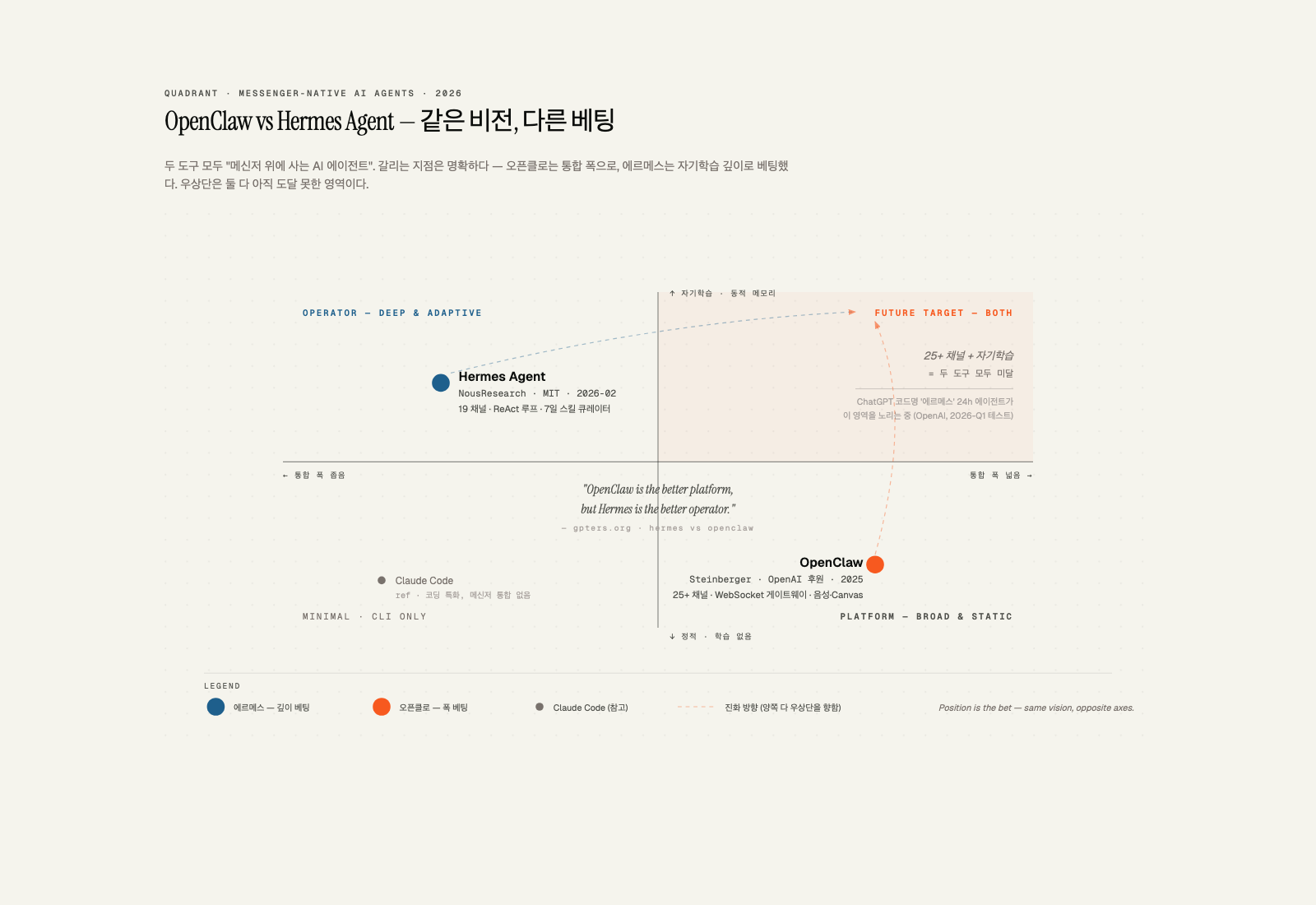
The positioning diagram summarizes the comparison visually. The tables and notes below give the specific figures behind it.
Core data
1. Basic facts about the two tools
| Category | OpenClaw | Hermes Agent |
|---|---|---|
| Creator | Peter Steinberger (founder of PSPDFKit) → joined OpenAI in February 2026, after which the project moved to an independent open-source foundation | NousResearch |
| Launch | Late 2025 (rebranded from Clawdbot) | February 26, 2026 |
| License | Open source (sponsored by OpenAI) | MIT |
| Base language | TypeScript / Node.js | Python 91.4% + Shell + JS |
| Models | Claude / GPT / Gemini / Ollama, freely selectable | OpenAI / Anthropic / Ollama / OpenRouter (any OpenAI-compatible API) |
| Installation | curl -fsSL https://openclaw.ai/install.sh | bash |
hermes CLI (runs locally, $5 VPS option) |
The most visible difference is the origin story. OpenClaw started as Clawdbot in late 2025 and was renamed later. Its creator then joined OpenAI in February 2026, and the project was moved to an independent open-source foundation that OpenAI supports. Hermes Agent comes from NousResearch, launched on February 26, 2026, and is released under the MIT license. The two projects are also built on different base languages. OpenClaw runs on TypeScript and Node.js, while Hermes Agent is mostly Python. That matters if you plan to read or modify the code, because your existing skills will transfer more easily to one of them.
Both tools let you choose your model. OpenClaw supports Claude, GPT, Gemini, and Ollama. Hermes Agent supports OpenAI, Anthropic, Ollama, and OpenRouter, and it works with any API that follows the OpenAI-compatible format. In practice, this means Hermes Agent has a slightly wider door for model swapping, which is useful if you want to change providers based on cost, speed, or privacy.
2. Messenger and tool integration
| Item | OpenClaw | Hermes Agent |
|---|---|---|
| Messenger channels | WhatsApp, Telegram, Slack, Discord, Signal, iMessage, Microsoft Teams, WebChat, and 25+ more | Telegram, Discord, Slack, WhatsApp, Signal, iMessage, Teams, and 19 in total |
| Gateway structure | Single WebSocket gateway (ws://127.0.0.1:18789) |
stdio MCP-based, with a per-channel adapter |
| External tools | Notion, Obsidian, Apple Notes, Things, Trello, GitHub, Spotify, Sonos, Philips Hue, Home Assistant | Any MCP server can be registered (e.g., Notion MCP, filesystem MCP) |
| Browser control | Built-in Chrome DevTools Protocol | Connected externally via MCP |
| Voice | ElevenLabs STT/TTS, wake-word support | Not included by default |
| Canvas (A2UI) | Real-time UI rendering workspace | None |
OpenClaw leads on breadth. It supports more than 25 messenger channels and connects to dozens of external tools, including smart-home devices, music services, and note-taking apps. It routes everything through a single WebSocket gateway, and it includes voice features and a live UI workspace called Canvas. The cost of this breadth is complexity, which shows up in the operating section below.
Hermes Agent covers 19 channels and handles external tools differently. Instead of shipping its own adapter for each service, it relies on MCP (Model Context Protocol) servers that you register yourself. If you already run a Notion MCP server or a filesystem MCP server, you can plug it in directly. You do not need to learn a separate integration layer for each app. Browser control also goes through MCP rather than being built in, and voice support is not included by default.
3. Operating characteristics
| Item | OpenClaw | Hermes Agent |
|---|---|---|
| Core philosophy | “All messengers + all tools through one gateway” | “A single agent that learns and grows on its own through a ReAct loop” |
| Memory | Static memory (stable but does not learn) | Dynamic memory — reviews conversations in the background and automatically turns them into skills; the skill library is curated on a 7-day cycle |
| Stability | Frequent session crashes and context loss (benchmark reports 3-4 times a day) | Stable thanks to minimal design |
| Token efficiency | About 5k tokens per request (about 5x Claude Code) | About 1k tokens per request |
| Automation | Built-in cron, webhooks, Gmail Pub/Sub | crontab + its own scheduler |
| Production readiness | Experimental and exploratory stage | Suited to a single operator |
The operating table shows the trade-off most clearly. OpenClaw’s memory is static. It is stable and predictable, but it does not learn from what you ask it to do. Hermes Agent’s memory is dynamic. It reviews conversations in the background, turns useful patterns into skills, and curates its skill library on a 7-day cycle. That design rewards repetition: the more often you ask for the same kind of work, the more the agent can reuse what it has already learned.
The cost side is just as important. The benchmark-based reports cited in the note say OpenClaw sessions crash or lose context 3-4 times a day, and each request uses about 5k tokens, roughly five times what Claude Code uses. Hermes Agent is described as minimal and stable, with about 1k tokens per request. Those numbers come from the note’s sources and are not independently verified here, but the direction is consistent with the design differences: a broad platform carries more moving parts than a single agent with a small surface area.
4. “Better platform vs better operator”
The most frequently quoted line in the community comparison is this:
“OpenClaw is the better platform, but Hermes is the better operator.” — gpters.org Hermes Agent comparison post
This sentence captures the difference better than any spec sheet. OpenClaw is strong as a platform: you can attach more channels and tools immediately. Hermes Agent is strong as an operator: the more work you give it, the better it handles that work. The distinction helps you decide what you are really buying. If your priority is reach, choose the platform. If your priority is accumulated competence on a recurring workload, choose the operator.
5. Security and policy notes
OpenClaw has a policy constraint you should not ignore. Plugging a Claude Pro or Max subscription directly into OpenClaw violates Anthropic’s terms of service. It can lead to account suspension, so the note recommends issuing a separate Anthropic API key and using that instead. The official documentation and a usage guide from daleseo.com both state this.
Hermes Agent sends model calls to external APIs. That means the cost and terms depend on which key you connect. The same tool can be cheap or expensive, and compliant or not, depending on the provider you choose. In my own setup, I use GPT-5.4 through the openai-codex provider, so the billing and terms are set by that provider’s agreement rather than by a consumer subscription.
Insights
1. Both aim to pull AI into messengers
Tools like Claude Code, Cursor, and Codex CLI are designed for people who sit in front of a terminal. OpenClaw and Hermes Agent both challenge that assumption. You can ask the same agent for help from Slack on your commute or from Telegram at home. When the messenger becomes the only interface, the AI stops being a place you go and becomes something you message. That shift is the shared direction of both tools.
2. OpenClaw bets on breadth, and Hermes bets on depth
OpenClaw connects more than 25 channels and dozens of external tools, including smart-home devices, music, and notes. It is a platform strategy: one gateway ties everything together. The price is weight. It consumes more tokens and crashes more often, and it requires you to manage a larger system.
Hermes Agent supports fewer channels, 19 in total, but it emphasizes something else. It combines a ReAct loop, self-learning memory, and a skill curator so that the same kind of task gets faster over time. Its strength accumulates rather than spreads out. For a person who repeats similar tasks every day, that accumulation is the more valuable feature.
3. What OpenAI hiring the OpenClaw founder signals
In February 2026, Peter Steinberger joined OpenAI, and the OpenClaw project moved to an independent open-source foundation with OpenAI’s support. In the same period, reports said OpenAI was testing a 24-hour autonomous agent feature in ChatGPT under the codename “Hermes.” That ChatGPT Hermes is a separate product from NousResearch’s Hermes Agent. Only the name is shared.
Read together, these developments suggest OpenAI is pursuing the autonomous agent market in two ways. First, it is adding a 24-hour agent to ChatGPT itself. Second, it is bringing in key talent behind messenger-integrated external agents like OpenClaw. The reasonable reading is that personal autonomous AI agents are likely to become a standard feature of ChatGPT within one to two years. That makes the choice between OpenClaw and Hermes Agent partly a question of how long you want a self-hosted tool to remain relevant.
4. Why Hermes Agent can fit a single operator
For a single operator who keeps an agent running on a Mac mini and calls it from outside through a Discord bot, Hermes Agent is a strong fit. There are three main reasons.
First, it is a single agent with self-learning, so the more repetitive your work, the lower the effective cost becomes. A pattern you teach it is saved as a skill and reused later.
Second, it supports free registration of MCP servers. If you already use a Notion MCP server or a filesystem MCP server, you can plug them in directly. You do not have to learn a separate adapter for each tool, as you would with OpenClaw.
Third, its model compatibility is broad. Any OpenAI-compatible API can work, so you can change models based on cost, speed, or privacy requirements without rebuilding your setup.
The trade-off is that Hermes Agent lacks the flashier features, such as voice and Canvas. If you need those, OpenClaw is the better choice.
5. Claude Code plus an agent is the realistic setup
Work that requires precise handling inside a code repository is still best done with Claude Code. It is not well suited to being sent from a messenger. Everyday automation that you trigger from outside, such as sorting email, checking the calendar, monitoring markets, or drafting content, feels awkward in Claude Code.
The practical answer is to run both categories of tool. Use Claude Code for coding and OpenClaw or Hermes Agent for operations. These tools do not really compete with each other. They work at different layers, and each covers a job the other handles poorly.
Related local files
- Hermes setup on the author’s Mac mini: section 11 of
~/Projects/shared/AGENT_GUIDE.md(Hermes Agent, Mac mini standalone) - Hermes configuration:
~/.hermes/config.yaml,~/.hermes/.env,~/.hermes/SOUL.md - Discord bot gateway: Jarvis2#0460, launchd service
ai.hermes.gateway
Bottom line
OpenClaw and Hermes Agent are not interchangeable. OpenClaw is the better choice when you need the widest range of messenger channels, smart-home and productivity integrations, voice, and a live UI, and you are willing to manage more complexity, higher token use, and occasional session crashes. Hermes Agent is the better choice for a single operator who wants a lightweight agent that gets better at recurring work through self-learning memory and MCP-based tool connections. Whichever you pick, check the model provider terms first, since using a consumer subscription inside OpenClaw can violate Anthropic’s terms. For most people with a coding workflow, the strongest setup is to keep Claude Code for repository work and add one of these agents for everyday automation.
Sources
- Hermes Agent: A Practical Guide to a Growing AI Agent - WikiDocs (WikiDocs is a Korean online book and documentation platform.)
- 01-1. What Is Hermes Agent? - WikiDocs
- Complete Hermes Agent Summary: Hermes vs OpenClaw Comparison - gpters.org (gpters.org is a Korean AI community site.)
- 01 OpenClaw - Vibe Coding - WikiDocs
- OpenClaw, the Hottest Tool Right Now: Installation Guide - codingapple.com (codingapple.com is a Korean coding education site.)
- OpenClaw: An AI Assistant in Your Messenger - daleseo.com (daleseo.com is a Korean developer blog.)
- OpenClaw vs Claude Code vs Agent Zero Comparison - bswen.com
- OpenAI Tests a 24-Hour “Hermes” Agent in ChatGPT - AI Times (AI Times is a Korean tech news outlet.)
- OpenAI Hires Key OpenClaw Talent - The Elec (The Elec is a Korean tech news outlet.)
- OpenClaw Official Documentation
Frequently asked questions
- Which should I choose, OpenClaw or Hermes Agent?
- Choose OpenClaw if you need many messenger channels and external integrations such as smart-home, music, and notes apps. Choose Hermes Agent if you want a lighter agent that gets better at repeated tasks and fits a single operator.
- Can I use a Claude Pro or Max subscription with OpenClaw?
- No, according to the note. Plugging a Claude Pro or Max subscription into OpenClaw violates Anthropic's terms and can get the account suspended. Use a separately issued Anthropic API key instead, as both the official documentation and a usage guide state.
Some links are affiliate links. If you sign up through them, BuildnWrite may earn a commission at no extra cost to you.
Tools in this post
BuildnWrite helps teams build AI agents that keep running. About BuildnWrite ›